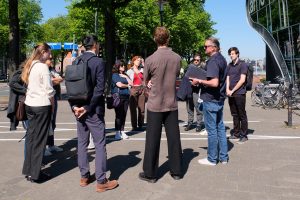
Lifestyles, geographies, sustainable travel: Dr. Li Wan
This post was written by Tuna Taşan-Kok.
As part of the UGoveRN-UP Dialogues Series, we were delighted to host Dr. Li Wan, Associate Professor of Urban Planning and Development at the University of Cambridge, Department of Land Economy, and Director for the MPhil in Planning, Growth and Regeneration, and Fellow of Gonville and Caius College. Dr. Wan delivered a keynote lecture titled “Sustainable Travel Revisited: A Lifestyle and Geographical Perspective” that offered both conceptual clarity and a pragmatic challenge: how can we truly decarbonise transport in ways that are socially just, context-sensitive, and politically feasible?
In a room filled with scholars and students of governance, mobility, and urban planning, Dr. Wan’s presentation unfolded along two interlinked perspectives, lifestyles and geographies, to address one of the most persistent failures in climate policy: transport remains the sector with the least progress on emissions reductions. Based on his current work as a principal investigator advising the UK Department for Transport, Wan called for a fundamental shift away from predictive transport models and average-based policy assumptions, towards a more differentiated and socially grounded approach.

Rethinking travel through lifestyles
The first half of the lecture questioned the traditional ways in which transport behavior is segmented and modeled in policy frameworks. Dr. Wan argued that a reliance on averages and static socio-economic categories obscures the real variation in people’s travel emissions. Using detailed data from the UK’s National Travel Survey, he revealed that similar weekly emissions can emerge from radically different patterns: one person may emit consistently every day, another might emit almost nothing except for a single flight on the weekend. These differences are not trivial, they shape the social and environmental effectiveness of policy interventions.
To make sense of this, Dr. Wan introduced a latent class modelling approach, clustering individuals into “emissions profiles” that reflect not only their total emissions but also when and how they travel. His findings challenge the simplistic assumption that high-income groups are always high emitters or that lower-income groups are always more sustainable. The picture, instead, is one of intra-group variation, mobility asymmetries, and structural constraints. Some high emitters are involuntary, driven by care responsibilities or poor transport options, while others exercise freedom enabled by affluence.
Dr. Wan’s critique was sharp: existing policy tools are ill-equipped to deal with this complexity. Designing effective interventions, he argued, requires acknowledging not only emissions volumes but also travel variability, lifestyle constraints, and the voluntariness of travel behavior. This means moving beyond mode-specific incentives and targeting the conditions that shape emissions-heavy lifestyles in the first place.
Uneven transport change in the UK
Turning to geography, Wan offered a sobering retrospective of the past 20 years of transport change across UK regions. His empirical breakdown showed how deeply uneven progress has been: London stands out as a rare success story of reduced car dependency and improved public transport use, while most other regions, especially in the north of England, have seen stagnation or backsliding. The pandemic, instead of accelerating sustainable shifts, reversed many of the gains from the 2000s.
These spatial differences raise difficult policy questions. Should investments prioritize the most carbon-intensive areas (efficiency) or aim to lift all regions equally (equity)? Is decarbonization a universal goal, or one that needs to be scaled to regional realities? Wan underscored that solutions cannot be one-size-fits-all: even public transport uptake or car use depends not just on infrastructure, but on economic geographies, employment distribution, and urban form. For example, core cities like Manchester or Birmingham show outlier patterns that differ markedly from their surrounding regions.
He concluded this section with a realistic, if sobering benchmark: over 20 years, most regions have seen less than a 6% change in transport emissions or modal share, a clear sign of the structural inertia faced by decarbonization policies.
A call for realism and political courage
Throughout the keynote, Dr. Wan was cautious not to overstate technological fixes. In fact, he argued that current innovations often make travel cheaper and easier, exacerbating emissions rather than reducing them. Real change, he suggested, requires making the perceived cost of unsustainable travel higher culturally, socially, and practically. That might mean less parking, slower streets, or new norms around car use. But more fundamentally, it requires reframing transport not merely as an individual choice, but as a deeply collective and political question.
The discussion that followed, moderated by Tuna Taşan-Kok and enriched by reactions from Professor Luca Bertolini of the UP Group and the audience. Professor Bertolini explored the political implications of Dr. Wan’s research and asked several relevant questions, which instigated further discussion among the audience: How can we design incentives that change deeply entrenched behaviors? How do we address involuntary high emitters without punishing the disadvantaged? What happens when mobility and global inequality intersect, for example, when a student from abroad becomes a high emitter by virtue of crossing borders? There was consensus on one point: mobility cannot be treated merely as a sectoral issue. It is embedded in how we live, work, care, and govern. As one participant put it, “mobility is not just movement, it’s a mirror of our values, systems, and inequalities.”
Dr. Wan’s lecture left us not with solutions, but with a better framework for asking the right questions. And sometimes, that is the most radical step in policymaking.
Tag:Keynotes

You may also like
Bridging top-down and bottom-up mobility policy

Regulatory tools for affordable housing