

Financialization and urban land rent in planning research
This post was written by Tuna Tasan-Kok.
This post is based on the Keynote Dialogue with Assoc. Prof. Dr. Barbara Pizzo (Sapienza Universita di Roma), SIU Conference (Societa Italiana Degli Urbanisti) – XXVIIth National Conference, 20 June 2025, https://www.societaurbanisti.it
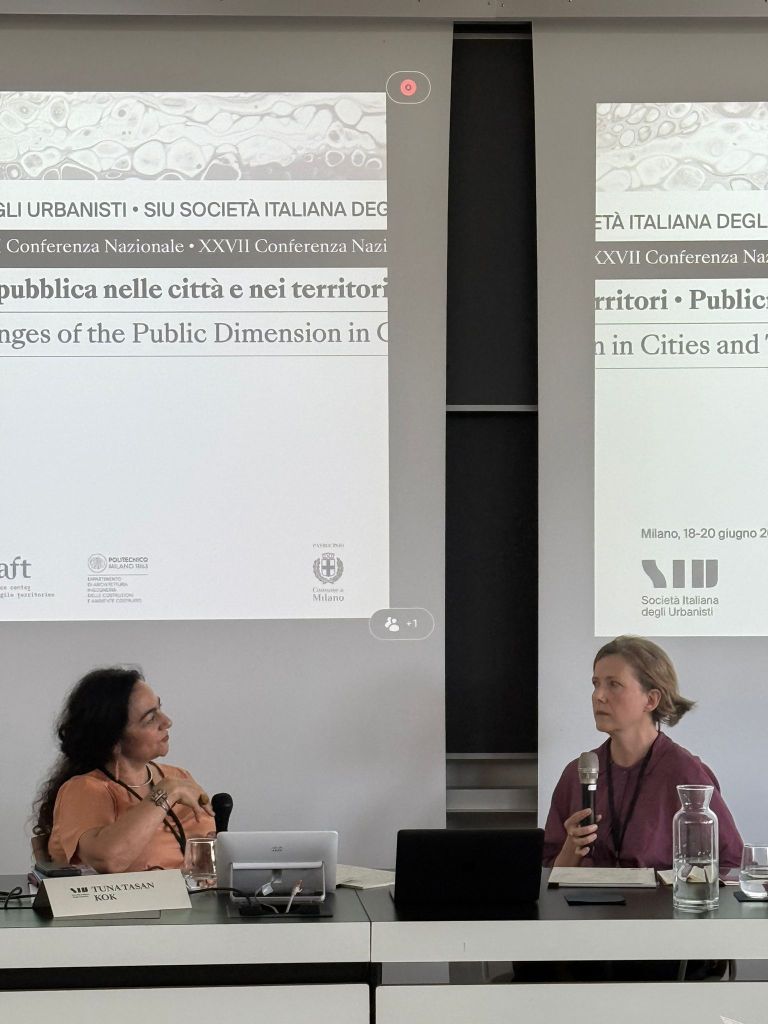
Is financialization theory becoming a conceptual ouroboros, a framework that explains everything and, in the process, risks explaining nothing? This was one of the provocative starting points in my recent dialogue with Professor Barbara Pizzo of the Sapienza University of Rome, at the SIU (Italian Society of Urban Planners) Conference, where we revisited and discussed the entangled relationship between finance, land rent, and urban transformation. Our conversation revolved around a shared concern: the growing disconnect between financialization theories and urban land rent theory in current research. The conversation offered a chance to push against some prevailing assumptions and to propose a more grounded, relational understanding of how value is produced and captured in cities.
We asked: What if financialization theory, in its search for patterns across global urban change, has grown too obsessed with flows, symbols, and abstract value extraction, and in doing so, lost sight of the ground beneath its feet? What if the apparent “financialization” of cities, the public listing of real estate companies, the growing dominance of investment funds like REITs, and the increasing role of asset managers in urban redevelopment, distracts us from the slow, messy politics of land rent, local institutions, and legal geographies that continue to shape value on the ground?
What I took from this dialogue is a renewed clarity around four ideas that had long been on my mind but were never fully articulated: the seductive yet limiting nature of financialization as a meta-narrative; the need to move beyond its surface appearances toward more grounded, place-based analysis; the overlooked but essential dialogue between land rent theory and financialization theories; and finally, the imperative to repoliticize the terrain of urban finance by bringing institutions, legal frameworks, and contestation back into focus.
The seductions and limits of the financialization meta-narrative
Financialization theory has undeniably reshaped how we understand urban change, exposing the role of global capital markets, asset managers, and new investment vehicles in reshaping cityscapes (see the trio of Manual Aalbers for further reading at Aalbers, 2018; 2019; 2020). Yet as we noted in our keynote exchange, the field risks becoming totalizing, presenting finance as a coherent and deterministic force, rather than a fragile, uneven, and deeply contested process. Given the fragmented, opportunity-driven, and property-led nature of urban development (Tasan-Kok and Ozogul, 2020), aren’t we attributing too much explanatory power to financialization, expecting it to account for everything in an urban landscape that is, in reality, shaped by diverse and often disconnected forces? Not every urban transformation is driven by finance, and in fact, local institutions, legal geographies, and political contestations still matter.
Much like the term neoliberalism a decade ago, financialization is perhaps now at risk of becoming a catch-all that obscures empirical complexity. In many accounts, finance appears as an omnipotent force, overriding politics, law, and spatial specificity. But does this reflect reality, or just the appearance of it?
From financial facade to grounded analysis
A key provocation I offered was this: Are we mistaking the financial facade of urban change for its drivers? The presence of financial actors, glossy fund logos, or companies going public may suggest that capital markets are in control, but what actually enables these processes? Often, it is the deeply situated rent-producing mechanisms: planning decisions, zoning reforms, infrastructure investments, state regulation, or shifts in tenure law.
Financialization may amplify value, but it does not create it from thin air. Here is where rent theory, in its classical, Marxist, and institutionalist forms, brings critical clarity. As David Harvey reminded us decades ago, the built environment is a “spatial fix,” but it is also the product of struggles over land, regulation, and access (Harvey, 1982).
Where is land rent in financialization theory, and vice versa?
Professor Pizzo remarked that it is time to reconnect financialization theory with land rent theory, not by collapsing one into the other, but by tracing how they have been mutually constituted over time, almost as if closing a long-unfinished circle. Indeed, it resonated with my thoughts on the advantages of linking financialization theories to urban rent theory. While financialization theories foreground abstraction and liquidity, rent theory insists on the material fixity and boundedness of land. This tension is productive. It opens space for thinking about how finance reshapes, but does not erase, spatial constraints.
For example, institutional investors in housing markets (Fields & Uffer, 2016; Aalbers, 2016) may operate across borders, but they remain dependent on local planning systems, rent laws, and growth coalitions to extract value. What is branded as assetization often depends on very specific regulatory and political processes that make land and housing income-generating in the first place.
Rent theory also sharpens financialization analysis. Terms like “value extraction” or “rentier capitalism” abound in critical urban studies, yet rarely do they clarify what kind of rent is being extracted as they reveal who captures value, how, and under what conditions (Haila, 1990).
Repoliticizing the terrain of urban finance?
In our dialogue, we discussed the idea of moving away from deterministic narratives and toward frameworks that take local contestations, legal geographies, and state institutions seriously. It is, in a way, a call for re-politicization of financialization. Instead of imagining finance as a “global wave” sweeping across urban space, this idea proposes seeing it as a series of contingent, situated interventions that depend on the manipulation of land-based value. What emerges from reconnecting rent and finance is a more grounded, relational political economy of the urban, one that does not overstate coherence, but maps the actor-landscapes, temporalities, and power asymmetries at play.
Finance needs rent to land; and rent, in our current era, cannot be understood without financial actors
To grasp how this plays out on the ground, it is crucial to examine the actor landscapes that anchor financial and governance logics to specific places. As I argued elsewhere (Tasan-Kok, 2021) these actors, developers, investors, local authorities, planners, are not just intermediaries but co-producers of spatial value. Their interactions and positionalities help determine what kinds of social value are created, legitimized, or excluded in particular places (Kady, et al., 2025). This relational lens is also reflected in my work on property-market intelligence (Tasan-Kok, 2025), investor typologies (Ozogul and Tasan-Kok, 2020), and urban change in Amsterdam’s property investment landscape (Tasan-Kok et al., (2021). Together, these studies emphasize the importance of unpacking how knowledge, capital, and governance intersect, not in the abstract, but through embedded practices that shape urban outcomes.
As a fitting coda to our exchange, I return to Barbara Pizzo’s compelling book (Pizzo, 2023) that I look forward to reading. Its title alone, “To live or die off rent”, captures the stark realities and political urgency surrounding contemporary urban rent regimes. In a world where the extraction of value from land increasingly overshadows its capacity to sustain life, inclusion, and collective futures, Pizzo’s work reminds us that the city of rent is not the sustainable city. Her call to confront rent not only as an economic mechanism but as a societal choice resonates deeply with the themes of our dialogue during the SIU Conference, and with the ongoing need to reclaim planning as a tool for justice, rather than a vehicle for extraction.
I thank the organizers of the SIU Conference for hosting this dialogue. A full recording and transcript will be made available soon in our website too!
Suggested readings
Aalbers, M. (2016). Financialization of housing (pp. 40-63). Oxfordshire, UK: Taylor & Francis.
Aalbers, M. B. (2018). Financial geography I: Geographies of tax. Progress in Human Geography, 42(6), 916-927.
Aalbers, M. B. (2019). Financial geography II: Financial geographies of housing and real estate. Progress in human geography, 43(2), 376-387.
Aalbers, M. B. (2020). Financial geography III: The financialization of the city. Progress in Human Geography, 44(3), 595-607.
Christophers, B. (2022). Rentier Capitalism: Who Owns the Economy, and Who Pays for It? Verso.
Fields, D., & Uffer, S. (2016). The financialisation of rental housing: A comparative analysis of New York City and Berlin. Urban studies, 53(7), 1486-1502.
Fine, B. (2019). Theories of Social Capital: Researchers Behaving Badly. Pluto Press.
Haila, A. (1990). The Theory of Land Rent at the Crossroads. Environment and Planning D: Society and Space, 8(3), 275-296. https://doi.org/10.1068/d080275
Harvey, D. (1982). The Limits to Capital. Oxford: Basil Blackwell
Kady, N., Özogul, S., & Tasan-Kok, T. (2024). Lost in translation: Unlocking planning’s potential to harness social value from property development projects. European Journal of Spatial Development, 21(4), 57-81.
Özogul, S., & Tasan-Kok, T. (2020). One and the Same? A Systematic Literature Review of Residential Property Investor Types. Journal of Planning Literature, 35(4), 475-494. https://doi.org/10.1177/0885412220944919
Pizzo, B. (2023). Vivere o morire di rendita: La rendita urbana nel XXI secolo. Rome: Donzelli editore
Tasan-Kok, T. (2021). New relational understandings of city building: Reading the city through dynamic landscapes of spatial governance. Transactions of the Association of European Schools of Planning, Vol. 5, Issue. 1, pp.1-8.
Taşan-Kok, T. (2025). Navigating the city: Role of property-market intelligence channels in urban governance networks. European Urban and Regional Studies, 32(2), 197-220. https://doi.org/10.1177/09697764241266411

You may also like

Did Urban Planners Get It Wrong?

