

Bridging top-down and bottom-up mobility policy
Co-creating ‘productive tension’ between stakeholders to support just urban transitions
This post was written by Niamh Moore-Cherry, Dean Phelan, Madeleine Gan, Rachel McArdle and Brian Caulfield .
Differential access to quality living environments in urban centres has been brought into sharp focus since the pandemic, highlighting significant socio‐spatial inequalities in housing, health, and income and environmental justice concerns (Kayanan et al., 2021). Coupled with the unanticipated political mobilisation around broader climate mitigation and biodiversity strategies such as in the backlash to 15 minute cities in Oxford, UK or in the origins of the gilets jaunes protests in France, questions arise as to how effective traditional processes of urban and regional governance are in a context of super-complexity and growing evidence of policy mis-steps and implementation gaps. Drawing on a range of scholars (Bodenhamer et al., 2015; Roberts, 2016; Clavin et al., 2021) and building on our webinar to the UGoveRN network in December 2024, we argue that more inclusive and sustainable cities, towns and rural areas, can only emerge if we engage in deeper dialogue that seeks to unearth and understand local concerns, histories, and vulnerabilities, and generate appropriate place‐based policy responses.
Co-creating opportunities for ‘productive tension’
Drawing on our research as part of the Research Ireland funded CONUNDRUM project and on a growing body of literature, we argue that critical co-creation can be a useful tool to make visible the issues that most affect wellbeing and quality of life, elucidate new and alternate forms of knowledges to build more inclusive engagement, and also potentially address some of the ‘implementation challenges’ facing policymakers and planners today. Perhaps the most recent iteration of collaborative (Healey 1997) or communicative planning (Innes 1998), the approach focuses on the role of planning in trying to mediate between different perspectives to foster shared understanding and create the conditions under which transformative practices can potentially emerge. Ermacora & Bullivant (2016) suggest that co‐creation as a method or tool of governance can remove the boundaries between experts and citizens and reconfigure participatory placemaking as a means of achieving more just outcomes. Critiques of the approach abound (Fawcett & Marsh, 2014; Flinders & Wood, 2014; Horvath and Carpenter 2020). However we build on Clavin et al.’s (2021) argument that co‐creation approaches can be a tool to surface, acknowledge, and highlight conflict, dissent, and injustice as a first and necessary step to enable meaningful interactions and new thinking.
Introducing the CONUNDRUM project and process
The aim of the CONUNDRUM project is to understand mobility in Irish towns and to reimagine how we could achieve more sustainable transport and mobility outside of our cities and support more resilient urban areas and sustainable communities by enabling government, citizens and enterprise to work more effectively together. We recognise that for communities without significant public transport infrastructure or financial resources to upgrade to private electric vehicles, a push to decarbonise mobility has the potential to further marginalise our most vulnerable groups particularly in smaller towns with less developed infrastructure. As such, while decarbonisation may be the ultimate policy objective, achieving just transitions to more sustainable mobility is key to meeting wide-spanning policy goals.

The CONUNDRUM project aims to address these participatory, knowledge and capability challenges through:
- A working process that empowers communities to identify local needs while enabling better utilisation of existing assets;
- The production, through co-creation methods, of a community-led mobility strategy that responds in a place-based way to national and international climate challenges and goals alongside greater local buy-in to effect meaningful change;
- A set of actions and the development of tools that simultaneously respond to government commitments, policy frameworks and address local community needs.
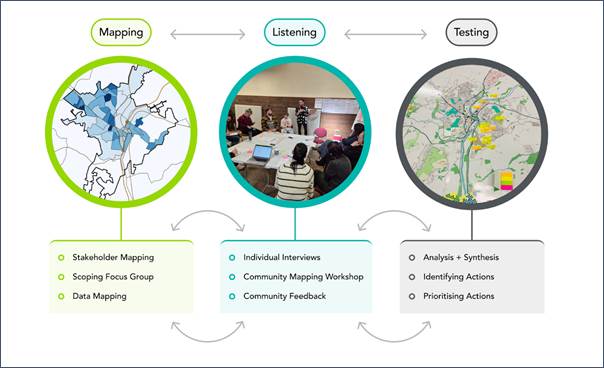
This involves a three-pillared approach (Figure 1) that involves ongoing engagement – from design to execution – with diverse sets of stakeholders who have different lived experiences of the existing challenges and opportunities in relation to mobility. It incorporates iterative engagement and feedback loops as indicated in Figure 1. The approach develops opportunities to co-create and enhance mobility options that are: place-based; empowering of local communities; fill knowledge gaps for policymakers; and generate earlier and more sustained buy-in to enhance effectiveness.
Testing the CONUNDRUM approach in Enniscorthy, County Wexford (Ireland)
Our pilot area has been the town of Enniscorthy in County Wexford (pop: 12,000) and we engaged 139 diverse stakeholders from three main stakeholder groups: residents and civil society groups; businesses; government and policymakers. Through stakeholder mapping, focus groups, in-person community mapping workshops, interviews, solution prioritisation and ranking exercises, and a range of formal and informal feedback mechanisms, our project evolved from identifying one challenge – high car dependence and poor sustainable mobility options – to uncover 132 individual challenges, many of which were overlapping. Our approach also uncovered 102 potential opportunities which we consolidated into 20 possible solutions to facilitate meaningful change. These were then ranked by 24 stakeholders to identify the top 5 priorities from which a set of 9 key action points were developed for a range of stakeholders. The output was a community-led mobility strategy for Enniscorthy that has local resonance, meaning, reflects lived experience and provides actionable and implementable direction for key decision-makers.
The value of co-creation in bridging top-down and bottom-up policy making
The approach we adopted positioned co-creation as a mechanism for developing productive tension between bottom-up and top-down approaches. Through creating a neutral space for dialogue and meaningful engagement, the challenges and constraints facing all actors were articulated which enhanced understanding, built trust and facilitated direct community engagement with decision-makers. Our events and workshops demonstrated a keen desire across all local actors to make policy work but also highlighted capacity and capability challenges within the local authority to translate national policy priorities into meaningful place-appropriate action. Through opening up a new approach to strategy making we demonstrate what Ziervogel et al. (2021, p. 607) describes: “if capacity building processes shift from the top-down transferal of existing knowledge to the co-creation of contextual understandings, they have the potential to deliver more transformative adaptation”.
At present, we are scaling and testing our approach in two other similar-sized Irish towns (Tramore, Co Waterford and Youghal, Co Cork) to test how replicable it might be as an innovative approach to mobility and transport governance. We are developing a suite of digital tools and training which will empower both communities and local authorities to innovate in terms of mobility governance. The CONUNDRUM project is illustrating how in a context of super-complexity and a challenging policy implementation environment, new modes of learning and forms of engagement that bridge bottom up and top-down traditional policy processes are required to ensure just urban transitions and ultimately strengthen local democracy.

You may also like
Unpacking urban power

How justice for some ends up jeopardizing justice for all
