

Interactions between real estate financialization and planning
This post was written by Alberto Bortolotti.
When I began my PhD in urban planning, design, and policy at the Polytechnic University of Milano, I had the objective to keep investigating the linkages between cities and large-scale projects, which was the topic of my master’s thesis. However, the focus of that research was only on the so-called ‘Milan Model’, thus scaled on the role that such projects exercise in the establishment of the narrative of prosperity delivered by the mayor and several Milanese private and public stakeholders to capture global investments.
During the same period, I was working as a teaching assistant in my supervisor’s course, and some students challenged me to provide more details related to the money invested in the urban mega-projects I explored during the master research, an issue usually quite poorly discussed by architects, scholars, observers who make research on such property operations, at least in Italy.
So, at that specific moment, it appeared crystal clear in my mind that I had to stress more on the financial angle of such projects, and I started to deepen real estate specifics of property operations, understanding that business plans are nowadays overlapping masterplans in site development. Thus, I discovered the financialization literature and all its broad implications.
In parallel, I started to interview relevant actors in the Milanese real estate and financial system, analyze planning and business documents underpinning significant property operations, and deeply study real estate finance and its interactions with spatial planning.
This work took two years and let me discover several implications which real estate financialization addresses on the planning theory and practice, particularly in transferring the financial ‘diversification theory’ to the planning-making.
In fact, over the last decades, financialization clustered large packages of capital investments in real estate, through sophisticated financial and regulatory devices enabled by States. Such a process massively contributed to securing strategic renewal projects and alienating public patrimonies, framing local governments as ‘absorbers’ of the investments’ risks and producing unexpected and ungoverned consequences on urbanity, gentrification, and housing costs.
In Milano, central, regional, and local governments have underpinned the financialization of real estate, slightly empowering the influence of global players investing and managing real estate assets along with an ‘enabling attitude’ in urban development. The Italian austerity and the limited spending capacity of the local governments place financialization as a relevant lever to stimulate private property operations and market-led policies in Milano. This scenario challenges the State, and the Milanese local government, to frame the ‘double ring’ of spatial and legal arrangements for unlocking real estate operations, thus reshaping itself as an enabler of real estate financialization.
The case of Milano shows that the uncertain nexus between the planning system and the property market empowers the latter, although spatial planning should affect financialized legal frames, not the contrary. In this decisional frame, financialized urban development, housing, and infrastructure decrease the potential Statecraft capacity addressed by the Milanese administration in providing public goods and governing the city-making, thus making the local government just an enabler, an activator of entry points for property financialization. Nonetheless, although several academic studies demonstrated that alternative uses of public patrimonies managed through corporate criteria do not empower the provision of public goods, I argue that the enhancement of local governments and state agencies in managing large-scale urban projects, the public-oriented governance of urban policies, and the reforming process of bureaucracies, can address a radical and paradigmatic change in State-enabling strategies, towards unpredicted circumstances in which the State covers a role both of ‘enabler’ and, again, a ‘crafter’ also in pro-growth contexts. In other words, a crafting role of the local governments (and the State) through the re-empowerment of state planning in delivering strategic, structural, and executive plans may fill the gap between major urban projects and global finance, thus fostering the government of urban rent and the embracement of new planning principles.
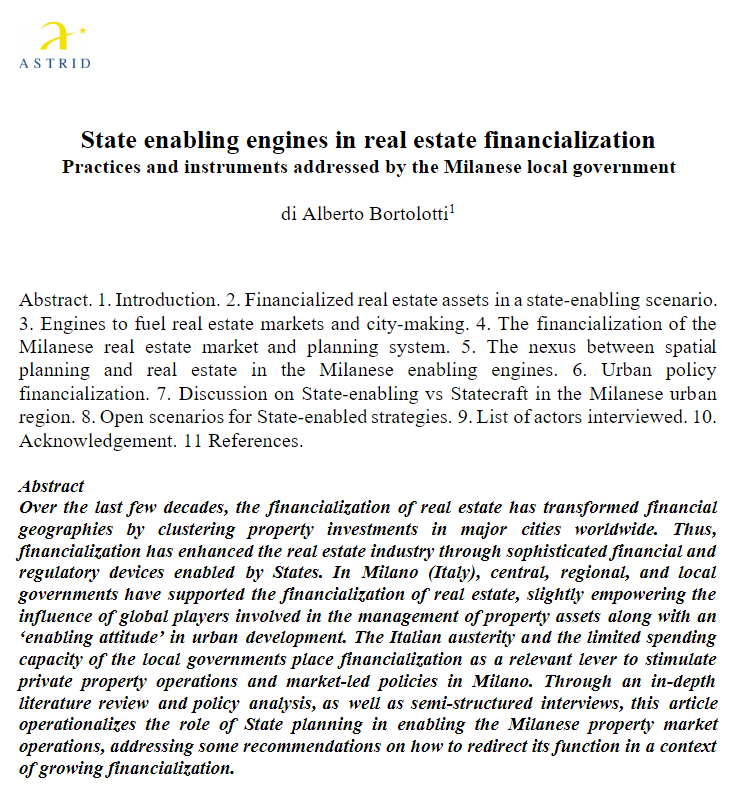
The ensemble of such observations intertwined with generalizations and results of the Milanese case is encompassed by the article ‘State enabling engines in real estate financialization. Practices and instruments addressed by the Milanese local government’ (Astrid, 2023) that you can read here.
Tag:Publications

You may also like

Summer festivals & the unjust consequences of safety regulations

