How justice for some ends up jeopardizing justice for all
Planning Conflict and the Case of Seventh Avenue in Bogotá, Colombia.
Urban Studies, Online first (2025)
This post was written by Nanke Verloo and Andres Galeano Salgado.
Although often approached as technical, urban developments are inherently political. Whether they concern urban regeneration, housing, infrastructure, or transport, spatial interventions mobilize citizens with local knowledge, experience, and demands that do not always align with those of administrators. Despite the widely adopted ambition to involve the public, contesting citizen groups are often ignored, excluded, or delegitimized. Our recently published paper (see the full paper in Urban Studies) proposes to use ‘Critical Moment Analysis’ to study the contentious interplay between citizens, planners and political leaders. We analyze the politics behind a progressive transport project in Bogotá, Colombia. The analysis reveals how planning agendas that aim to address justice for some, tend to simultaneously choose one voice over another, and thereby end up jeopardizing justice for all.
Whereas participation processes organized by local governments often expect citizens to voice their concerns via formal channels and highly orchestrated moments of public meetings, citizens use all sorts of informal practices to voice their stories in and outside formal participatory frameworks. To understand the interplay between these formal and informal planning politics, we introduce the methodology of Critical Moments (CMs) as a novel analytical framework to study planning conflicts. The CM framework focuses on how power dynamics and political actions shape contentious planning processes. Critical Moments reveal the complex interplay between formal governance and informal citizen action, highlighting the temporal and relational dimensions of conflict and power in urban transport decision-making. Critical moments are pivotal points in contentious processes characterized by uncertainty, disruption of existing power relations, and significant consequences that reshape stakeholders’ political action repertoires. This approach allows researchers to dissect how different actors—including government officials, planners, and various citizen groups—perceive, respond to, and influence planning processes over time, often in conflicting ways.
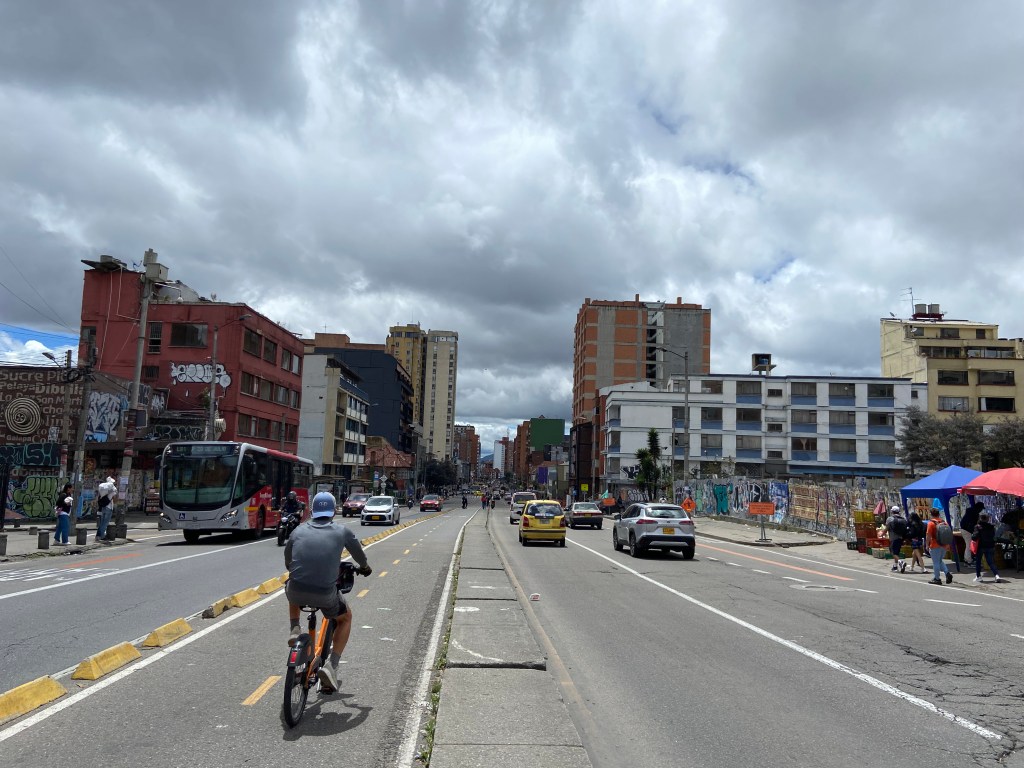
Seventh Avenue and 51st Street, Bogotá, August 2023. Photo by N Verloo
We apply the methodology to a case of transport conflict in Bogotá, Colombia. Based on 1.5 years of ethnographic research, we analyze the politics surrounding the redevelopment of Seventh Avenue. The case of Bogotá’s Seventh Avenue serves as a paradigmatic example of transport politics in a highly unequal urban context. The project aimed to transform the avenue into a Green Corridor featuring a Bus Rapid Transit (BRT) system designed to enhance mobility justice for peripheral, low-income communities who face disproportionate commuting burdens. Despite its progressive intentions and extensive participatory planning efforts, the project encountered fierce opposition from affluent northeastern neighborhoods. These residents felt marginalized by the participatory process, which prioritized the needs of peripheral communities, resulting in protests, legal challenges, and political conflicts that ultimately stalled and ultimately canceled the project.
The article identifies four key critical moments in the decision-making process over this contentious transport planning process that dominated local politics for years:
Critical Moment 1: Participatory Meetings (2020): The administration initiated a participatory process focusing on improving mobility for marginalized peripheral populations. While this process was considered critical by officials, residents of the affluent northeastern corridor largely disregarded it, citing participation fatigue and perceiving the process as ineffective or exclusionary.
Critical Moment 2: Informal Meeting at the Urban Development Institute (IDU) (2022): For the residents of the northeast, the planning process became important when they discovered that the project designs diverged from earlier promises, particularly regarding traffic restrictions in the northeast. This critical moment galvanized opposition and led to the formation of a protest group, marking a significant shift in power dynamics that the administration ignored. For them, the emerging protest group was not the project’s target, and their demands were not representative of the cause.
Period of Non-Critical Moments: After the critical moment at the IDU, a period of protest started. We conceptualize this period as one of Non-Critical Moments that, although the informal politics of contestation affected the public debate, they did not change power relations or reshape stakeholders action repertoires. The citizen group developed a myriad of strategies and tactics —ongoing protests, political debates, media engagement, and informal citizen actions—that sought to influence the planning process. But because of the administration’s ability to ignore these moments and the continuous delegitimization of the group as “elites who do not think for the public good, but just want to drive their cars”, the protest attempts were excluded from the planning process in the larger process of urban politics.

Participant Observations in local council debate, Bogotá, April 2023, photo by N Verloo.
Critical Moment 3: Opening of the Bidding Process (2023): The start of the bidding process was the third critical moment altering the relations and actions of stakeholders, but it was the first CM recognized simultaneously by both the administration and protestors. It represented a tangible step toward project implementation, but also heightened uncertainty and mobilized legal challenges from the opposition.
Critical Moment 4: Lack of Proposals for Contested Sections (2023): The failure to attract bids for key sections of the project underscored the political and juridical uncertainties surrounding the initiative. This outcome effectively halted the project, shifting power toward private developers and signaling the project’s demise.

Protest against Seventh Avenue Developments, Bogotá, June 2023. Photo by A. Galeano.
We argue that critical moment analysis offers three major insights that are relevant to all types of contentious planning projects:
- Unintended Consequences of Exclusion: Despite the administration’s progressive agenda aimed at enhancing transport justice for marginalized groups, excluding other citizen political actions—particularly from wealthier neighborhoods—backfired. The framing of opposition as NIMBYism (Not In My Backyard) delegitimized dissent but ultimately undermined the project’s legitimacy and feasibility. Although the project aimed at inclusive planning, in practice, the voice of one group of residents was more salient than that of another. While aiming to achieve transport justice for some, the project jeopardized justice for all.
- Equivalence of Critical and Non-Critical Moments: Both high-impact turning points and continuous, less visible political actions, shape the trajectory of transport conflicts. Non-critical moments, such as protests and political maneuvering, play a crucial role in sustaining opposition and influencing broader political dynamics, underscoring the need to consider the full spectrum of political activity in contentious planning processes.
- Procedural Justice and Participation Timing: The case reveals a mismatch between the administration’s timing and form of participation and citizens’ expectations and preferences. Participation was front-loaded during early project stages, while many citizens wanted to engage later when designs were more concrete. Recognizing protest as a valid form of participation and synchronizing participatory processes with citizens’ engagement rhythms are essential for procedural justice.
The article situates Critical Moment analysis within broader critical urban studies that conceptualize power in transport politics through agenda setting, institutional capacities, and mechanisms of inclusion and exclusion. It highlights how power operates not only through formal planning and legal channels but also through informal political actions and the recognition—or misrecognition—of stakeholders’ political performances.
Critical Moment analysis requires urban scholars to combine ethnographic fieldwork, narrative interviews, timeline construction, and comparative analysis of stakeholder perspectives to capture the temporal and relational complexity of transport politics. This approach reveals how different actors’ timelines and perceptions of critical moments often lack synchrony, leading to misrecognition, exclusion from public discourse, and conflict escalation.
The article concludes that CM analysis offers a powerful tool for understanding and navigating the shifting power dynamics in transport planning, particularly in unequal urban contexts. It underscores the necessity for cities to broaden their conceptualization of citizen participation, integrate formal and informal political actions, and manage conflicts relationally and substantively throughout the decision-making process.
To enhance spatial justice and participatory planning, the study recommends that administrations recognize diverse political actions, avoid framing opposition solely as obstructionist, and create ongoing spaces for contestation and dialogue that align with citizens’ temporal and substantive engagement preferences. Future comparative research using CM analysis can further elucidate how socio-economic class and other structural inequalities shape transport politics and the outcomes of citizen mobilization in planning conflicts.

You may also like
Unpacking urban power
Bridging top-down and bottom-up mobility policy