Densification policy and contractual housing arrangements
This post was written by Elise F. Jansen.
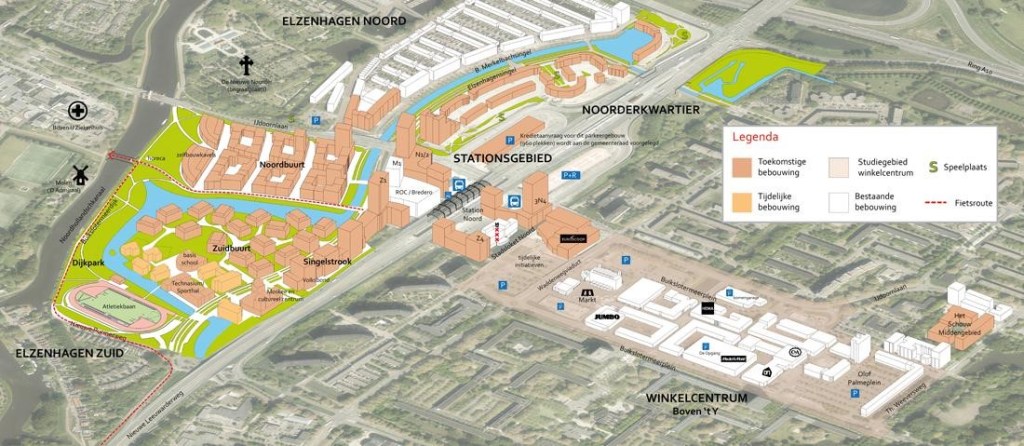
In this blog I describe the findings from my master thesis in Urban and Regional Planning titled “The influence of flexible densification policy on contractual arrangements of affordable housing”. The primary research question of this thesis is: How do flexible densification policies influence contractual arrangements of affordable housing? The research was based on a case study approach, focusing on the three sub-area developments Elzenhagen Noord, Elzenhagen Zuid and Noorderkwartier within the broader Centrumgebied Amsterdam Noord (CAN) area development in the North of Amsterdam (Figure 1). In this case study, flexible densification policy influenced contractual arrangements of affordable housing (AH) indirectly through indicative plans. The case study exemplifies adaptive planning, which is responsive to uncertainties in dynamic urban environments. Adaptive planning utilizes changes to steer societally desired outcomes, such as the development of affordable housing (Rauws, 2015).
A shift from rigidity to flexibility
In the beginning of the development process of CAN around 1999, there were policy documents which indicated areas suitable for ‘net densification’, such as the area of Elzenhagen Noord, Elzenhagen Zuid and Noorderkwartier. Net densification required compensating for building on greenfields by adding greenery. The indicative policy documents were in the beginning rigidly formulated and consisted mostly out of quantitative policy objectives.
Following the financial crisis of 2008, new indicative policy documents emerged, characterized by guided flexibility. Under guided flexibility, rules are flexible enough to facilitate non-linear decision-making, but not too flexible to let the private interest prevail (Tasan-Kok, 2008). Guiding rules provide adaptiveness to uncertainties during the development process (Rauws, 2015).
The shift from rigidity to guided flexibility was driven by two primary factors. First, the uncertainty experienced during the financial crisis necessitated more flexible policies. Second, conflicts between quantitative and qualitative densification policy objectives highlighted the need for more flexible approaches. Initially, the focus was on ‘net densification,’ Later, it became permissible to compensate for the loss of greenery by enhancing the quality of remaining green spaces. This shows that guided flexibility does not only create the ability to move within rules, but also the ability to change the rules. For instance, the later introduced indicative policy documents focused on higher densities than the former.
Adaptiveness to unforeseen circumstances
Van den Hurk and Tasan-Kok (2020) found that contractual arrangements adapt to unforeseen circumstances. De Roo, Hillier and Van Wezemael (2012) mentioned that contractual arrangements do not just include contracts, but are a long-term adaptive process. In the case study of Elzenhagen Noord, Elzenhagen Zuid and Noorderkwartier in the CAN area, contracts included contingency provisions allowing deviations from the negotiated content under unforeseen circumstances, such as changes in market conditions, political views, or administrative changes by the district. Both formal and complete contracting practices were recognized in the sub-areas.
Influences through indicative plans
By doing archival research and interviews on policy documents, indicative plans, notations and contracts, I found that flexible densification policies influence indicative plans, which in turn affect the content of contractual arrangements of affordable housing. Therefore, the influence of flexible densification policies on contractual arrangements is indirect, mediated through the mechanism of indicative plans. Increased density in policies prompted changes to higher densities in indicative plans, leading to a larger amount of affordable housing. Uncertainties such as the financial crisis, delays in the construction of the metro line, and changes in middle-income housing legislation also impacted the indicative plans.

Flexibility in contractual arrangements
The introduction of several new indicative policy documents during the development process concerning densification and indicative plans were considered as unforeseen circumstances under the contingency provisions, allowing for contract modifications. The contractual arrangement of affordable housing was flexible in two crucial ways. Firstly, this arrangement allowed for adaptable cooperation between the municipality and the developer’s consortium. The first framework agreement from 1995 was based on a concession governance model. In this model, the implementation of the entire development, including the realization of the public space, is carried out by private actors. A subsequent declaration of intent in 2002 shifted the model to a combination of concession and private development, favoured by private actors due to the increased scope and complexity of the indicative plan. The municipality became responsible for the realization of the public space.
Secondly, flexibility was embedded within the housing program. The new 2005 framework agreement was supported by an indicative plan (Stedenbouwkundig plan CAN). Each sub-area later received an implementation agreement with a corresponding indicative plan (Stedenbouwkundige uitwerkingsplannen). Rauws, Cook, and Van Dijk (2014) noted that indicative sub-plans and temporary land use could enhance an area’s adaptability. The indicative sub-plans in Elzenhagen Noord, Elzenhagen Zuid and Noorderkwartier deviated from the indicative plan in the framework agreement regarding the amount of housing and inclusionary zoning. The amount of affordable housing increased in the sub-areas Noorderkwartier and Elzenhagen Zuid by building in green areas and by reducing the water surface. In the sub-area Elzenhagen Zuid there was temporary housing, which made adaptive use of space possible. The inclusionary zoning minimum of 30 percent in the framework agreement from 2005 was flexible, because in each implementation agreement different percentages could be written down for a sub-area. In the end, the percentage of affordable housing in the CAN area had to be 30 percent.

Flexible densification policies influence contractual arrangements of AH
In the case study of the sub-areas Elzenhagen Noord, Elzenhagen Zuid, and Noorderkwartier within CAN an indirect influence of flexible densification policies on contractual arrangements of affordable housing was recognized. The indirect influence was through the mechanism of indicative plans. In the sub-areas combined, more affordable housing units were developed than originally written down in the first framework agreement and indicative plan. The guided flexibility in policy documents stimulated the production of affordable housing.
Policymakers could adopt guided flexibility in densification policies to facilitate adaptive responses to unforeseen circumstances. This guided flexibility could be used to steer urban development to societally desired outcomes. The combination of robustness and openness in guiding rules needs to be monitored, since excessive flexibility could lead to adverse outcomes in urban developments.

You may also like

Where people move but homes don’t