
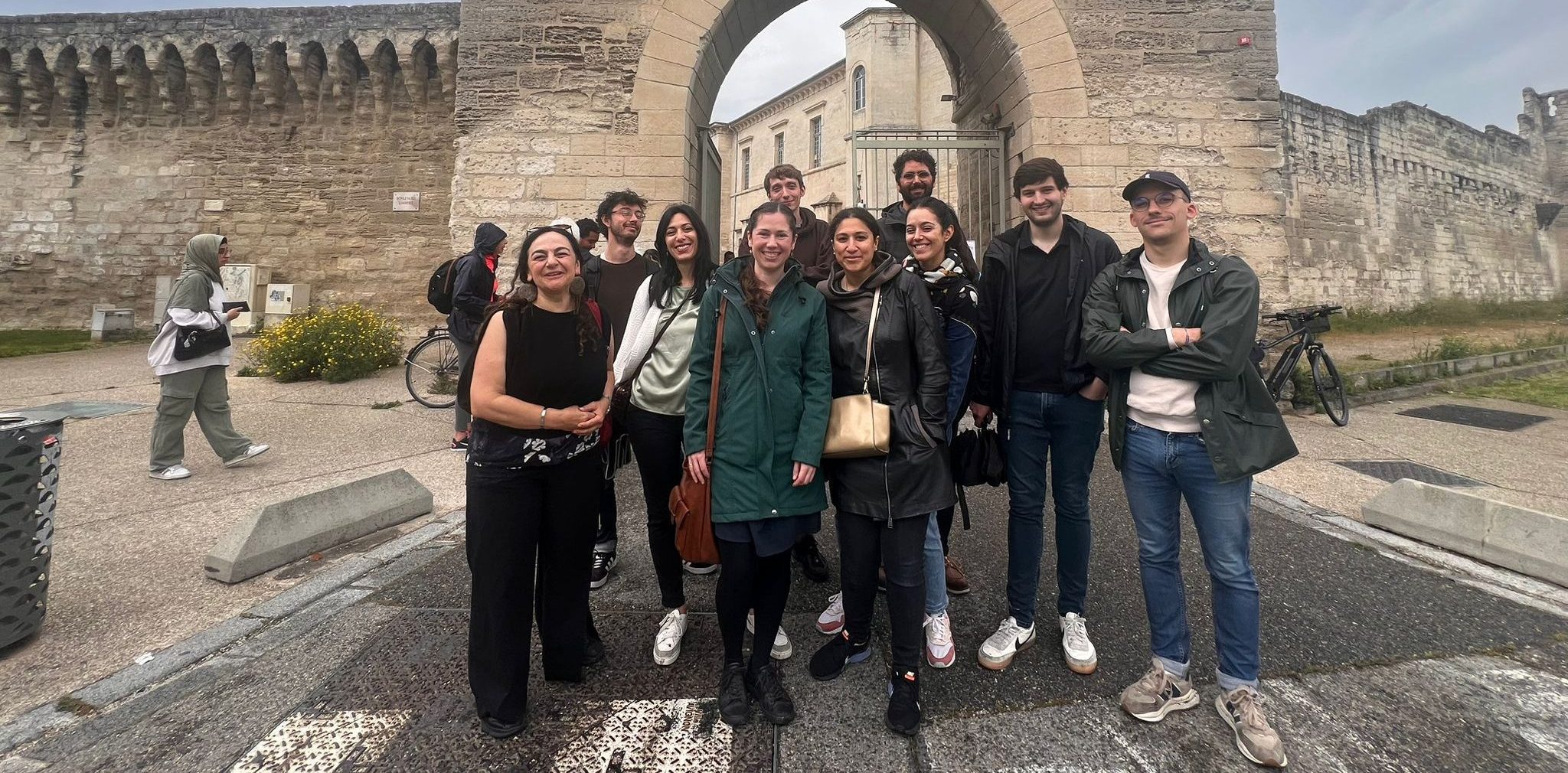
A joint GIF & UGoveRN symposium in Avignon
The Governance of Land, Property Owners & Real Estate
This post was written by Anna Hug.
I recently returned from a four-day visit to Avignon, where I participated in a joint Symposium of the Geodata for Real Estate Research Chair (GIF) and UGoveRN at the University of Avignon alongside Tuna Tasan-Kok (University of Amsterdam), Sara Özogul (University of Groningen), Andre Legarza (University of Amsterdam), Nagwa Kady (University of Amsterdam), Laure Casanova Renault (GIF, University of Avignon), Guilhem Boulay (GIF, University of Avignon), Pierre le Brun (GIF, University of Avignon), Antoine Peris (GIF, University of Avignon), Rémi Lei (GIF, University of Avignon), Rémi Delattre (GIF, University of Avignon), and Thibault Lecourt (GIF, University of Avignon). Its focus was on the governance of land, property ownership, and real estate.

Following some customary sightseeing in the city centre, we convened with the Avignon team on Monday and Tuesday to share our research findings, which, despite a common focus, showcased distinct methodological approaches. While our counterparts presented quantitative analyses of land ownership, usage patterns, regulations, and real estate dynamics in France, our research emphasised theoretical frameworks and conceptual models of urban governance, primarily rooted in the Dutch context.

The first day of the symposium featured presentations by the French scholars, elucidating key policy pillars such as social housing, homeownership, and buy-to-let schemes prevalent in the French context. Notably, there was an emphasis on promoting social mixing within housing policies, which we would experience in the field during our excursion the next day. Data presented indicated that a significant proportion of the housing stock in France is privately owned, with institutional investors holding less than 5%. Surprisingly, there has been a recent increase in public land ownership.
However, challenges regarding reconciling environmental and social objectives, particularly in relation to housing provision, poses a conundrum also observed in the Netherlands. To state a specific example in France, environmental goals on EU level were recently translated to the no net land take, a binding policy. As a municipality, you won’t be able to hand out building permits anymore if you don’t reach the goal by 2031 – but you’re also required to build a significant amount of houses per year. Discussions in the afternoon highlighted the fragmentation present on various dimensions evident in both cases.

On the second day we embarked on an excursion from the city center to the suburbs, focusing on public spaces and social housing. Overlooking the urban landscape from an elevated public space they explained the extended territorial development of the area, landownership dynamics, and housing prices. Within the case of an old prison that is currently repurposed to housing they visualised mechanisms and policies introduced the day before, such as financial incentives (e.g., tax benefits for renovation), and constraints (e.g., flooding area).

In the outskirts, ‘extra muros’, a tram took us to a popular swimming pool and a large area where municipal and inter-municipal governments collaborated in providing public space. Returning to campus, collaborative research opportunities were explored through group discussions, leading to the formulation of concrete proposals.
Overall, the symposium proved to be not only insightful but also inspiring and motivating, fostering valuable exchanges among researchers with diverse perspectives and expertise. Thank you everyone for a great experience. And special thanks to member Pierre le Brun for organising and to the Madeleine Julie Vervoort Fonds for supporting my participation.
Tag:Events

You may also like

Did Urban Planners Get It Wrong?

