
Urban governance meets polarised realities
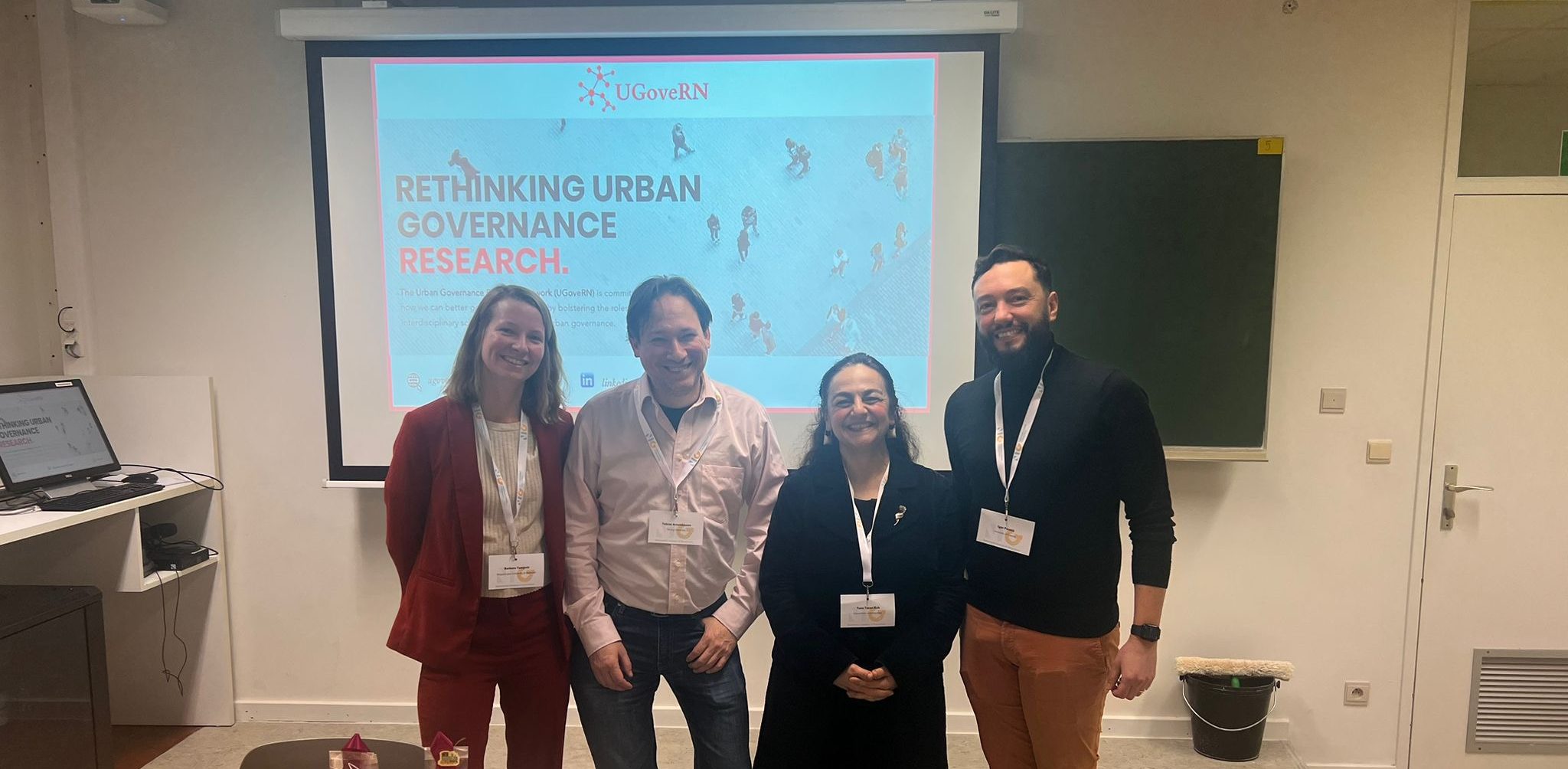
UGoveRN’s First Panel at NIG UGhent
This post was written by Igor Pessoa.
The Event
Last week, the UGoveRN organised a panel (more like a small track) at the NIG (Netherlands Institute of Governance) 2024/25 conference at Ghent University. It was an important milestone for interdisciplinary urban governance research since it was the first time NIG had a dedicated panel for the theme. As members of UGoveRN, we find this a unique opportunity to strengthen our multidisciplinarity outreach, receive innovative feedback, and interact with Public Administration scholarship. Despite NIG being open to different perspectives on Governance, it has traditionally received contributions predominantly from scholars in the Public Administration field. Therefore, it was valuable to experience how urban governance was approached and discussed, and to explore the ways in which UGoveRN can meaningfully contribute to NIG. It was a clear win-win.

For this inaugural panel, the core discussion topic proposed was “urban governance in times of polarisation and densification.” We are currently seeing a growing polarised society (socially, economically, and politically), but at the same time, we live closer to each other in urban areas. These dynamics pose numerous challenges for urban governance, as illustrated by our six presentations covering an engaging array of topics from diverse perspectives.
The Contributions
The six papers collectively explored how urban growth, political polarization, and social inequalities shape governance structures and urban life in a time of increasing polarization and densification.

Interconnected themes emerged across the presentations, particularly around the challenges of governing cities in times of political division and rapid urban expansion. For instance, the paper from Pieterjan Schraepen on Bordeaux Métropole and my own paper on Brazil’s Urban Governance underscore the necessity of pragmatic governance strategies amid deep political divides. While Bordeaux focuses on the integration of its metropolitan region to foster cohesive governance, Brazil’s urban administrations, despite the political polarisation between regions and the federal administration, managed to maintain practical, inclusive governance strategies to address urban challenges like inequality and public health. Both studies highlighted that in the face of ideological divisions, cities often strive for pragmatic solutions that transcend partisan lines, emphasizing the importance of local leadership.
Polarisation and urbanisation emerged as a critical concern in studies of urban sprawl and densification. The study of Ankara’s periphery, by Ender Iplikci from Bauhaus-Universität Weimar, focused on the fragmented nature of urbanization, where increasing density and urban sprawl have led to social segregation and inequality. This contrasts with the more integrated and cooperative governance model proposed for Bordeaux, where political shifts are encouraging regional cooperation to address the challenges of urban expansion. Ankara’s case highlights the dark side of densification, suggesting that rapid, uncoordinated growth can exacerbate social divides, which is in stark contrast to the more planned and regulated approach advocated in the adaptive governance paper of our member Tobias Arnouldussen from Tilburg University. This paper, focusing on participatory planning in multiple European contexts, emphasizes the importance of adaptive and inclusive governance systems that can better respond to complex urban dynamics, such as those seen in Bordeaux and Ankara.
Social inequality and densification were also prominent in the discussions of energy transition and urban planning. The energy vulnerability study presented by Laura Shllaku of Ghent University delved into the social implications of urban energy transitions, particularly for underprivileged neighbourhoods. It draws attention to the potential for gentrification and exclusion in urban renewal projects, a concern that mirrors the fragmentation observed in Ankara’s densification processes. The study emphasized that energy transition efforts should be inclusive, recognizing the role of intermediaries in bridging the gap between sustainability goals and the needs of marginalized communities.
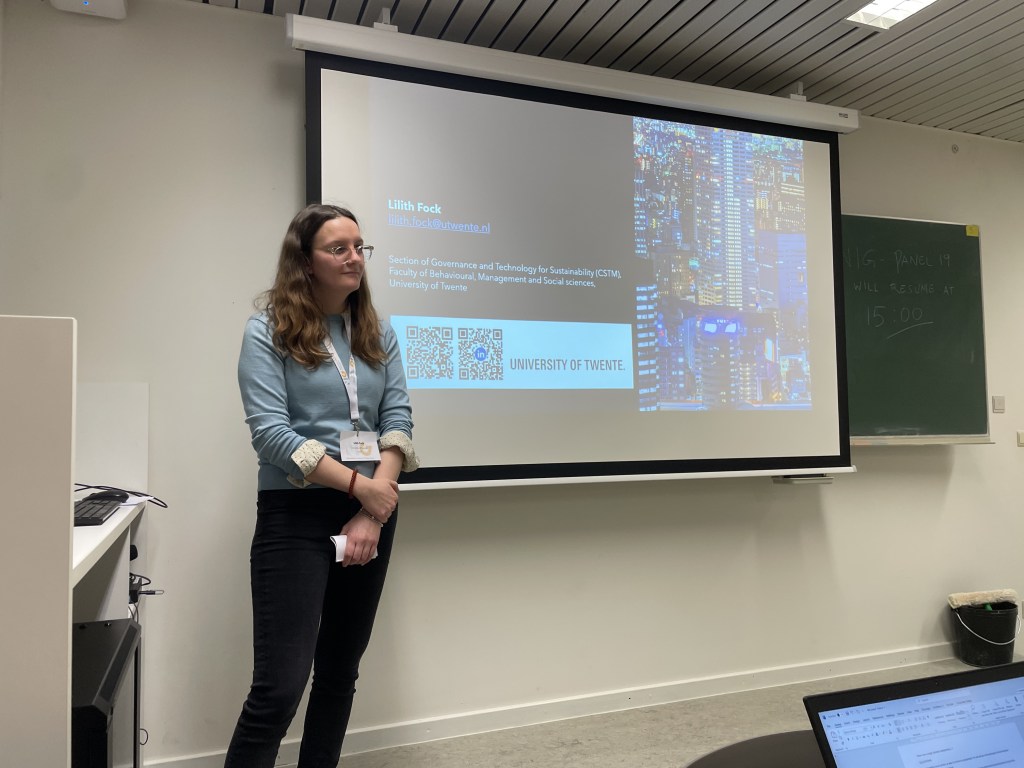
Finally, the City Networks paper of Lilith Fock from the University of Twente added an additional layer of complexity to the discussion, questioning the effectiveness of city networks in global governance. While this paper does not directly address the urban-rural divide or densification, it complements the other studies by challenging the assumptions about the effectiveness of governance networks and the need for rigorous evaluation of urban policy impacts. It highlighted the importance of critically assessing how cities, despite their diverse governance models, can influence global and local climate adaptation efforts.
In summary, while the papers present distinct case studies from different regions, they converge on the idea that pragmatic responses to polarization and densification increasingly characterize urban governance. We collectively agreed that cities, despite varying political climates, are striving to implement inclusive and adaptive strategies to address pressing challenges like inequality, social exclusion, and urban sprawl. However, these challenges also reveal the contradictions of urban growth, while densification can offer opportunities for regional cooperation, it can also exacerbate social divides if not managed with attention to equity and inclusion.
Relevance to the Dutch context
As discussed by David Evers in a UGoveRN post, the 2020 National Environment and Planning Strategy of the Netherlands, Nationale Omgevingsvisie (NOVI), represents a political movement to centralise spatial strategy than a strategic or technical choice. He highlighted how empowering cooperation between different levels is much more needed since different policy areas have different (de)centralisation dynamics. The discussions on the Urban Governance panel at NIG made me reflect that this is considerably more challenging on times of polarisation.
Let’s take the issue of citizen participation. NOVI very strongly supports citizen participation. It is a core component of the country’s spatial planning approach. However, while the NOVI encourages participation, it does not provide detailed frameworks for how this should be effectively realised, leaving open several potential challenges, particularly in times of political polarisation and rapid densification.
The papers presented in the panel highlighted key dynamics that are deeply relevant to this gap in the NOVI’s approach. As explored in the Brazilian case, the importance of pragmatic leadership and cooperation across political divides becomes apparent. When citizens are expected to engage in planning processes, polarised contexts can hinder effective dialogue and collaborative decision-making, as evidenced by the tensions between political ideologies in Brazilian cities. This is especially critical when urban growth is intertwined with political dynamics, as seen in the fragmented urbanisation process in Ankara, where rapid densification and sprawling peripheral areas contribute to social segregation. In this context, a lack of clear participation mechanisms can exacerbate existing divides and make governance more fragmented.
Similarly, adaptive governance frameworks emphasise the need for participatory models that can be flexible and adaptive to urban changes. Yet, without a clear strategy for managing participation, particularly when urban areas are undergoing rapid transformation, the risk of either exclusion or ineffective decision-making increases. In times of densification, where urban growth often creates competing interests among residents, developers, and local governments, open-ended participation without structured engagement risks deepening social inequalities and reducing the effectiveness of governance systems.
The NOVI’s call for participation in governance aligns with the panel’s emphasis on the need for inclusive, adaptive, and pragmatic strategies in urban planning. However, the lack of detailed (and comprehensive) guidance on managing participation suggests a significant gap in the strategy. Ensuring that participatory processes are not only inclusive but also genuinely effective requires a more nuanced approach that can address the complexities highlighted by the panel, particularly around fostering cooperation across diverse and polarised urban populations.
Tag:Events

You may also like

Where people move but homes don’t

