
The myth of the perfect scale
This post was written by David Evers.
[The text was originally published in Dutch in Rooilijn, which can be accessed here: https://www.rooilijn.nl/artikelen/zin-en-onzin-van-decentralisatie/]
After two decades of decentralizing spatial planning, the National Environment and Planning Strategy (NOVI) announced more national control. Afterwards, a Ministry of Housing and Spatial Planning (VRO) was (re)established and a new national spatial strategy is in the make. By placing this upwards movement in a historical context, we see that (de)centralization is primarily a political rather than a substantive choice. Because spatial developments and the consequences of spatial interventions rarely fit administrative boundaries, no administrative layer is ideal. For planning, it is then not so much a question of locating power but empowering cooperation. Because related policy areas such as housing, nature, energy and agriculture have their own (de)centralization dynamics, this becomes a complex matter.
Planning and governance
Determining how land should be used is both a democratic and a technocratic exercise. Spatial planning is all about making a sound decision between competing land uses without losing sight of long-term interests (Hamers et al. 2021). Ideally, problems are tackled at the administrative level at which they occur, but this is usually difficult to determine. Consider the diffuse boundaries of housing markets, economic clusters and river basins. ‘The region’ is often touted as the right scale for spatial tasks, but regional borders overlap considerably. In the Netherlands we have different sizes and shapes for police regions, renewable energy regions and metropolitan regions – all with different aims and legal status. Because of this, planning generally occurs at the three statutory levels: central government, province and municipality. Given a preponderance of wicked problems facing the Netherlands, spatial planning is constantly struggling with the issue of scale, also called multilevel or vertical governance in the international literature (bijv. Schijndel and Wal 2011; Spit and Zoete 2006). As a rather holistic policy area, spatial planning also struggles to coordinate other policy areas, also known as cross- sectoral or horizontal governance (Voogd 2001).
Propelled by the housing crisis, political priority is being devoted to finding suitable locations for about one million homes. At the same time, the nitrogen and climate crisis has increased the awareness that the Netherlands is too small to honor all land-use claims (Hamers et al. 2021). The return of national direction to tackle these tasks is experienced by planners as a kind of renaissance. But is centralization the answer? In a European research project on sustainable urbanization, decentralization was mentioned as often as centralization as a success factor for interventions (Cotella, Evers, and Gaupp-Berghausen 2020). Similarly, the federalist Germany and unitary France are European leaders in policies to reduce urban development on greenfields (ESPON 2024). Further research into this has revealed that the way in which government levels interact is more important than the legal division of powers (Jahning 2024). This should be reason enough to critically examine the current call for more central government control.
The rise and fall of national spatial planning
With the 2021 and 2031 amendments to the 1901 Housing Act, supra-municipal planning is over a century old, and with it the tensions between administrative levels in spatial planning (van der Wouden, Evers, and Kuiper 2011). Over time, there have been shifts in leadership. In the postwar period, the national government played an important guiding role in determining residential and work locations, which has produced internationally acclaimed planning concepts such as growth centers, mainports, the Green Heart and buffer zones (Faludi and van der Valk 1994; van der Wouden 2015).
This changed around the turn of the century. In line with the dismantling of the welfare state and discourse about the increased complexity of the network society, national government intervention in planning was considered passé (Hajer and Zonneveld 2000). Following the electoral victory of a new right populist party and its entry into government, the National Spatial Planning Agency was dismantled, and a neoliberal national strategy adopted. The Spatial Memorandum (2004) lacked a spatial vision for the country, but instead posited a vision on public administration: decentralize whenever possible, centralize only when necessary. This was followed by more institutional demolition: the abolition of the National Spatial Planning Commission (2008), the Ministry of Housing, Spatial Planning and the Environment (2010) and the planning inspectorate (2011). In the following year, the National Policy Strategy for Infrastructure and Spatial Planning (SVIR) went a step further than its predecessor by abandoning virtually all remaining planning policies in order to “make the Netherlands competitive, accessible, liveable and safe” (Ministerie IenM 2012:9). The philosophy is that citizens and businesses should be given more say in land-use decision making and that municipalities and provinces are better equipped to coordinate these decisions. Because the decentralization was not accompanied by extra funding to lower authorities, but an encouragement that they too should be non-interventionist, it can be more accurately be described as a deregulation of planning rather than a delegation of planning. Or as the former director of the Spatial Planning Agency put it: “No, this is no transfer of power, here a minister is simply disposing of an entire policy area” (Derksen 2011:30–31).
During this period, provinces became the de facto highest tier of planning. As a result, the Netherlands consisted of twelve spatial planning regimes alongside one another; rules for industrial estates or retail, for instance, can change considerably when one crosses the border between Groningen and Drenthe (Evers 2015). In academic circles, the world-famous national planning doctrine was proclaimed dead (Faludi 2011; Zonneveld and Evers 2014). In 2015, the planning community organized a series of events in honor of reaching the time horizon of the last real national spatial strategy (the 1991 Vinex). The national government was criticized for shirking its responsibility and seven challenges were identified that, according to the planners, demanded national guidance (de Boer 2015)Ministry of Infrastructure and the Environment embraced this diagnosis (Ministerie IenM 2017).
Rising up again
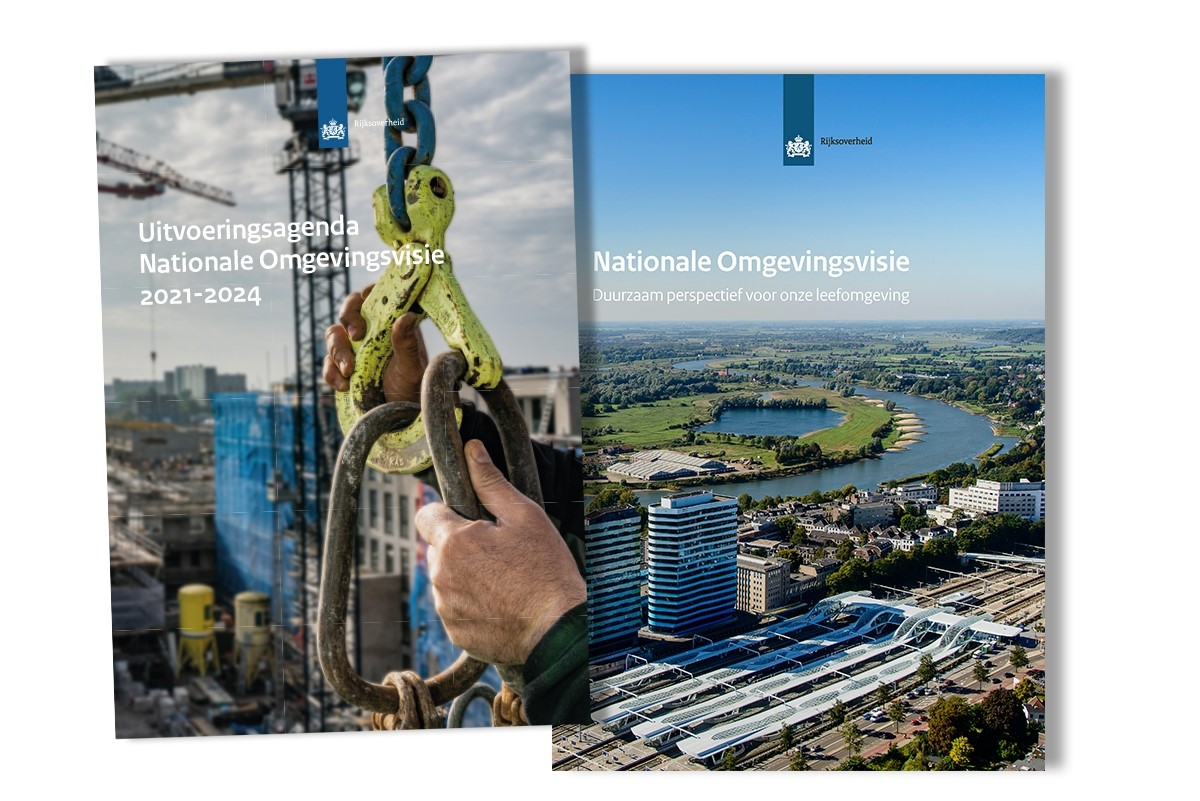
Ever since, we have seen a clear centralization trend. The 2020 National Environment and Planning Strategy (NOVI) begins with the words: “Urgent, large and complex challenges such as climate change, the energy transition, circular economy, accessibility and housing construction will significantly change the Netherlands […] The national government must and wants to take the lead” (Ministerie BzK 2020:4). Here, the logic of the SVIR is reversed. Importantly, the NOVI resuscitates urbanization policy, which should occur “as much as possible in existing urban areas, and in a climate-proof and nature-inclusive manner” (p. 5). The SVIR abolished the buffer zones and similar policies, but the NOVI states: “Large open spaces between cities should retain their green character. The supply and quality of green space in the city should be strengthened, and the connection to the hinterlands improved” (p. 5). Interestingly, the NOVI was mainly criticized in the press because it did not go far enough (Geise and Jonkman 2021).
In addition to policy, we see institutional and political rebuilding. The charismatic and well-known politician Hugo de Jonge (CDA) was selected as Minister for Housing and Spatial Planning (VRO). The Minister pledged to address the housing shortage and spoke passionately about spatial planning as a source of national pride (de Jonge 2023). Dissatisfied with the low level of decisiveness in the NOVI, the Minister proclaimed he would draft a bolder policy. In the meantime, various national environmental programs were set up, development areas of national interest designated and regional deals for housing construction concluded. In May 2022, de Jonge sent a highly ambitious letter to the Dutch parliament on spatial planning (de Jonge 2022). There can be no mistake: Dutch national planning is back.
Still, the efforts to take back control cannot be compared to national planning in the golden times of yesteryear. Recent events in vertical governance are illustrative of this. At the end of 2022, Minister de Jonge sent a letter to the provinces announcing a period of pressure-cooker planning in preparation for the new national planning strategy. The provinces were assigned the task to draw up ‘spatial proposals’ that incorporate long list of goals and demands from a score of national programs into policies and maps – against a tight deadline (Ministerie BzK 2022). One could say that the real work of spatial planning, namely balancing land-use interests (called ‘puzzling’ in Dutch policy circles), was delegated to provinces. When submitting their proposals, the provinces included their own list of demands of the national government. For example, they insisted clarity about certain structuring policy choices and “assessment frameworks for spatial quality, well-being, and water and soil management” (Kuiper 2024:11). Contrary to what proponents of decentralization would expect, the lower authorities desired less, not more, freedom. At the same time, the Environment and Planning Act – designed in the era of decentralization and intended to discourage top-down regulation – is now finally entering into force. In conclusion, we can stipulate that (de)centralization is an ongoing matter. Power is constantly going up and down like a yo-yo.
A multiplicity of yo-yos
Spatial planning becomes even more complex when horizontal governance (cross-sectoral coordination) is considered. This is important, because national spatial planning has historically had few resources of its own and is therefore dependent on policy areas that do. To reach its goals, it must align itself with more powerful departments. However, these policy areas are also undergoing waves of (de)centralization. As a result, the decentralization of spatial planning in the period 2000-2015 and its centralization thereafter do not run synchronously with its allies. A few examples can illustrate this further.
Historically, the most important ally is housing. The ambitious Vinex planning policy came a year after the weakening of the position of the housing associations, traditionally the implementers of urban development policy. As a result, spatial planning had to learn to deal with strategic land positions of market parties, something which still does not always go smoothly. The definitive separation came with the abolition of the Ministry of VROM. With the relocation of spatial planning to the Ministry of Infrastructure and the Environment and the inclusion of spatial quality in the Multi-Year Program for Infrastructure, Space and Transport (MIRT), an alliance with infrastructure policy was expected, but this did not really materialize. Perhaps because the latter did not feel it needed planning.
For nature policy, the yo-yos are more in synch. In the 1980s, the national government took control of the policy, designating the Ecological Main Structure in the 1990s, after which it was uploaded to the EU level as Natura 2000. The implementation of this policy under the strict supervision of the Rural Area Service occurred simultaneously with other major projects such as the Vinex districts and Room for the River. In 2012, together with the decentralization of spatial planning, nature policy was left up to the provinces (van Dam et al. 2024:26–27), while the legal framework remains at the EU level.
For wind energy, something quite different occurred: vertical governance experienced turbulence. Around 2000, wind policy was shifted to provinces, corresponding with the decentralization of spatial planning. However, rising European targets after 2008 prompted a strong recentralization. A policy issued by both the Ministry of Infrastructure and Environment and the Ministry of Economic Affairs (responsible for renewable energy) designated areas for wind farms, allowing for the application of powerful top-down legal planning instruments (Ministerie IenM and Ministerie EZ 2014). This helped to achieve the quantitative target, provoked considerable resistance (Evers, Nabielek, and Tennekes 2019). So much so that energy policy was decentralized to regions around 2018, about the same time as spatial planning started to rise up. Even though the two yo-yos in this case are out of step, this has not led to less involvement. Indeed, energy is increasingly seen as a policy partner.
The question remains how to deal with this complexity. One could hope that (de)centralization in spatial planning is well aligned with that of the other departments. Getting things done means skillfully navigating between moving scales. The examples show that this does not mean that the yoyos must move in tandem.
What next?
The return of central government control has been going on for almost a decade. From a discursive point of view, the use of language is striking. For example, the national design program ‘Mooi Nederland’ takes its name from a short-lived program in 2008 when the then Minister of Housing, Spatial Planning and the Environment, Jacqueline Cramer (PvdA), tried to fend off decentralization for a while. Minister de Jonge’s new strategy takes its name from the 2004 Spatial Memorandum. The Ministry of Housing, Spatial Planning and the Environment has returned (only without the department ‘Environment’ because Brussels is doing that now). Is this evidence of a renaissance, rewriting history or simple nostalgia? With the political landslide towards right-wing populism, the continuation of centralization of planning is far from certain. Although the coalition agreement is not openly hostile to spatial planning – with the LPF in the Balkenende I cabinet (2002) and the PVV in Rutte I (2010) that was a completely different story – the cabinet does prioritize short-term interests (PBL 2024), which is principally at odds with a discipline focused on foresight and strategic action.
One of the slogans of the current government is that “every region counts” (PVV et al. 2024). If such regional thinking becomes politically dominant, there may be an increased demand for regionalization of powers, including spatial planning. This could conceivably halt the centralization. It could also disrupt the administrative momentum created by the provincial proposals. The same applies to a possible centralization of energy policy in response to new political priorities: this could undermine the institutional capital that has been built up in the regional energy strategies and hence their link to planning (PBL 2024). The same is of course true for other allied policy areas. In this turbulent time, it is better to focus on how to work together across scales than trying to find the right scale level to make plans.
Sources
de Boer, Yves. 2015. Terugblik op het Jaar van de Ruimte. Den Haag: Platform31.
Cotella, Giancarlo, David Evers, and Mailin Gaupp-Berghausen. 2020. ESPON SUPER Final Report Annex 2: Evidence on Interventions. Luxembourg: ESPON.
van Dam, Frank, Leo Pols, Machteld Schoolenberg, and Clara Veerkamp. 2024. Naar een breder gedragen natuurbeleid in Nederland. Den Haag: pla.
Derksen, Wim. 2011. “Regio’s En Gemeenten Aan Zet!” S&RO, 34–35.
ESPON. 2024. No Net Land Take Policies and Practices in European Regions. Final Report. Luxembourg: ESPON.
Evers, David. 2015. “Formal Institutional Change and Informal Institutional Persistence: The Case of Dutch Provinces Implementing the Spatial Planning Act.” Environment and Planning C: Government and Policy 33(2):428–44. doi: 10.1068/c1391.
Evers, David, Pia Nabielek, and Joost Tennekes. 2019. Wind-op-land: lessen en ervaringen: een reflectie op de implementatie van windenergie vanuit een ruimtelijk perspectief. Den Haag: Planbureau voor de Leefomgeving.
Faludi, Andreas. 2011. “Geen Drager Voor Ruimtelijke Planningsdoctrine.” S&RO, 34–35.
Faludi, Andreas, and Arnold van der Valk. 1994. Rule and Order: Dutch Planning Doctrine in the Twentieth Century. Dordrecht: Kluwer.
Geise, Jonas, and Arend Jonkman. 2021. “Waarom Is Rijksregie Het Antwoord Op Ruimtelijke Opgaven?” Rooilijn 54(1):1–10.
Hajer, Maarten, and Wil Zonneveld. 2000. “Spatial Planning in the Network Society-Rethinking the Principles of Planning in the Netherlands.” European Planning Studies 8(3):337–55. doi: 10.1080/713666411.
Hamers, David, Rienk Kuiper, Ries Van der Wouden, Frank van Dam, Frank Van Gaalen, Anton van Hoorn, Jelle Van Minnen, Leo Pols, and Jan Ritsema van Eck. 2021. Grote Opgaven in Een Beperkte Ruimte. Ruimtelijke Keuzes Voor Een Toekomstbestendige Leefomgeving. 4318. Den Haag: Planbureau voor de Leefomgeving.
Jahning, Mariam. 2024. “Does State Structure Matter? How Does State Structure Influence the Implementation of No Net Land Take Policy in Germany and France?” MA, University of Amsterdam, Amsterdam.
de Jonge, Hugo. 2022. Nationale regie in de ruimtelijke ordening. Kamerstuk vergaderjaar 2021-2022, 34 682, nr. 92. Den Haag: Ministerie BzK.
de Jonge, Hugo. 2023. “Speech minister De Jonge bij de Planologielezing.” Nieuwssite BZK. Retrieved September 23, 2024 (https://www.nieuwsbzk.nl/toespraken/2466373.aspx?t=Speech-minister-De-Jonge-bij-de-Planologielezing).
Kuiper, Rienk. 2024. Provinciale Voorstellen Voor Omgevingsbeleid in Nationale Samenhang. Den Haag: Planbureau voor de Leefomgeving.
Ministerie BzK. 2020. Nationale Omgevingsvisie (NOVI). Den Haag: Ministerie van Binnenlandse Zaken en Koninkrijksrelaties.
Ministerie BzK. 2022. “Provinciaal Startpakket Fysieke Leefomgeving.”
Ministerie IenM. 2012. Structuurvisie Infrastructuur En Ruimte. Den Haag: Ministerie IenM.
Ministerie IenM. 2017. De Opgaven Voor de Nationale Omgevingsvisie. Den Haag: Ministerie IenM.
Ministerie IenM, and Ministerie EZ. 2014. Structuurvisie Windenergie Op Land. Den Haag.
PBL. 2024. “Reflectie PBL op het Hoofdlijnenakkoord 2024-2028: Aanbevelingen voor het nieuwe kabinet.”
PVV, VVD, NSC, and BBB. 2024. “Hoop, Lef En Trots – Hoofdlijnenakkoord 2024 – 2028.”
Schijndel, Barbara van, and H. A. M. van der Wal. 2011. Basisboek ruimtelijke ordening en planologie. Groningen [etc.: Noordhoff.
Spit, Theodoor Johannes Maria, and Paul Reinier Zoete. 2006. Ruimtelijke Ordening in Nederland: Een Wetenschappelijke Introductie in Het Vakgebied. Sdu uitgevers.
Voogd, H. 2001. Facetten van de planologie. Dordrecht: Kluwer.
van der Wouden, Ries. 2015. De Ruimtelijke Metamorfose van Nederland 1988–2015. Rotterdam: NAi Uitgevers.
van der Wouden, Ries, David Evers, and Rienk Kuiper. 2011. “De Veranderende Positie van de Nationale Ruimtelijke Ordening in Nederland.” Ruimte & Maatschappij 2(2–3):6–24.
Zonneveld, Wil, and David Evers. 2014. “Dutch National Spatial Planning at the End of an Era.” Pp. 61–82 in Spatial Planning Systems and Practices in Europe: A Comparative Perspective on Continuity and Changes, edited by M. Reimer. New York: Routledge.

You may also like

Summer festivals & the unjust consequences of safety regulations

Bridging top-down and bottom-up mobility policy
