

Market-intelligence channels in urban governance
This post was written by Tuna Tasan-Kok.
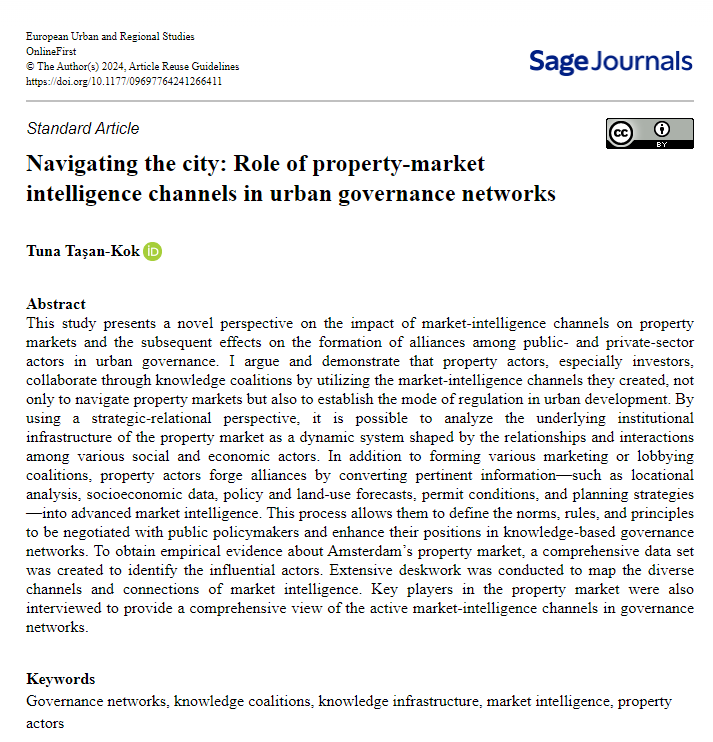
In the intricate world of urban development, property-market decisions are woven from a complex web of uncertainty, strategy, and collaboration. This complexity is thoroughly examined in Tuna Taşan-Kok’s article, “Navigating the City: Role of Property-Market Intelligence Channels in Urban Governance Networks,” published in European Urban and Regional Studies. The study provides a detailed analysis of how market-intelligence channels influence property markets and shape alliances between public and private sectors within urban governance.
This research is particularly significant because unbiased studies on the property market are rare, as highlighted by Özogul et al. There’s an urgent need for a fresh perspective on entrepreneurial governance, where the boundaries between the public and private sectors often blur. To truly understand what drives collaboration among property market actors in this competitive environment, it’s essential to delve deeper, moving beyond traditional analyses. As Campbell et al. (2013: 45) suggest, this means exploring the connections between the ‘worlds of constraint and possibility.’
The power of market intelligence
Market intelligence has become a vital tool for property actors, particularly investors, who must navigate the unpredictable terrain of urban development. These actors form knowledge coalitions, leveraging market-intelligence channels to establish their authority and shape urban governance. By converting locational analysis, socioeconomic data, policy forecasts, and planning strategies into advanced market intelligence, they become key players in setting the rules and norms that govern urban development.
Three distinct types of market intelligence channels play pivotal roles in shaping urban governance networks: property-data providers, knowledge platforms, and professional and social networks. Property-data providers offer crucial quantitative and qualitative information on market conditions, helping actors make informed decisions. Knowledge platforms go beyond raw data by providing refined analyses that set industry norms, influence policy, and shape market trends. Professional and social networks foster connections among actors, facilitating collaboration and trust-building through both formal and informal interactions. The identification and categorization of these channels highlight the intricate and often hidden mechanisms through which property actors navigate and influence urban development.
Urban governance in a new light
A strategic-relational perspective reveals that property markets are not merely influenced by economic forces but are social constructs shaped by relationships between various actors. This perspective shifts the focus from viewing markets as static structures to understanding them as dynamic systems of interaction. Property-market intelligence channels serve as conduits for these interactions, creating interdependencies that shape both market conditions and governance networks.
Case study: Amsterdam’s urban landscape
Amsterdam’s shift from plan-led to market-led urban development illustrates how property investors navigate regulated planning frameworks. Through extensive data collection and interviews with key property-market actors, the study maps out the diverse channels of market intelligence that influence governance networks in Amsterdam. The case of Amsterdam, with its unique blend of global investors and local governance structures, shows how market intelligence not only facilitates investment but also blurs the lines between public and private sector roles in urban development. This shift has significant implications for how cities are governed, demonstrating the growing power of property actors in shaping urban spaces.
Implications for urban governance studies
This article addresses a significant gap in the literature as studies that explore the influence of property investors on urban development are rarely published in critical urban studies, planning, and geography fields. This research is crucial in shedding light on the hidden mechanisms that drive investor behaviour and shape urban policy by examining market-intelligence channels like property-data providers, knowledge platforms, and professional networks. Understanding these dynamics is essential for grasping how property actors exert power, establish norms, and form strategic alliances that influence the structure of cities. This work not only highlights the pivotal role of property markets in urban governance but also urges scholars and practitioners to reevaluate how these forces are studied and understood, paving the way for more comprehensive and impactful governance strategies.
The full paper, published in European Urban and Regional Studies, can be accessed here: https://journals.sagepub.com/doi/full/10.1177/09697764241266411
Tag:Publications

You may also like

Where people move but homes don’t

