Regulatory tools for affordable housing
From policy to practice in fragmented planning systems
This post was written by Ebru Kurt-Özman.
Setting the scene: Why we came together
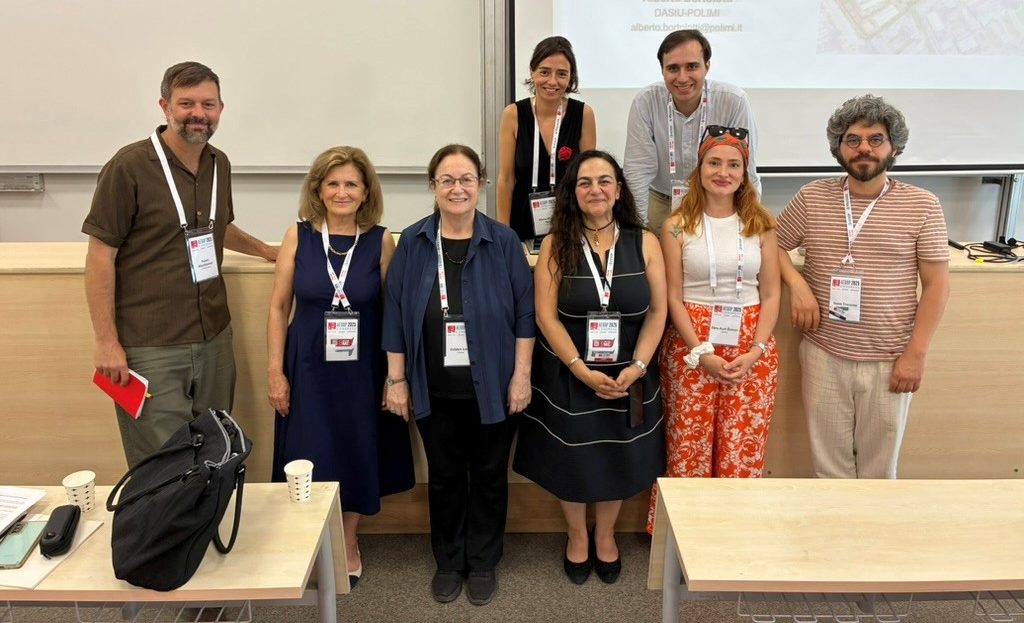
Held on July 8, 2025, at the AESOP Annual Congress in Istanbul, our UGoveRN roundtable titled “From Policy to Practice: Innovative Regulatory Tools for Addressing the Affordable Housing Crisis” aimed to bring together diverse experiences and regulatory approaches to one of the most urgent urban policy challenges of our time. We, as conveners and speakers, gathered not only to present tools and policies but to collectively reflect on what it takes to govern housing under growing constraints: political, financial, and institutional.
Co-organized by myself (Ebru Kurt-Özman, UGoveRN) and Nuno Travasso (University of Coimbra), and chaired by UGoveRN founder Prof. Tuna Taşan-Kok, this session functioned as a platform for international dialogue and mutual learning to exchange regulatory experiences rooted in different planning cultures. We brought together contributors working on housing regulation in Turkey, the U.S., Portugal, Italy, the Netherlands, and Germany to discuss how regulation operates in practice, what works (or doesn’t), and which lessons might travel across contexts.
Our motivation was clear: housing is increasingly governed through fragmented systems, regularly at odds with each other. National governments design policies without sufficient local data or implementation tools; municipal actors struggle with underfunded mandates; and in many contexts, private developers and consultancy firms take on increasingly public roles. These conditions demand not only new regulatory instruments but also new ways of thinking about the governance of housing.
What we asked, and why it matters
The roundtable was designed to answer four main questions:
- What innovative regulatory tools have emerged to address the affordable housing crisis?
- How do these tools perform in different governance settings?
- What factors shape their success, failure, or unintended consequences?
- Can we meaningfully compare and adapt these tools across contexts while acknowledging deeply embedded differences?
We also framed the conversation around transferability – not as a blind replication of best practices, but as a generative dialogue around policy design, implementation capacity, and political culture. In other words, what can planners and policymakers borrow, adjust, or reimagine?
Diving into the tools: Highlights from the roundtable discussion
Each speaker brought a unique perspective, shaped by their national housing systems and local governance realities:

Paavo Monkkonen (UCLA, UGoveRN member) focused on generating local revenue for subsidized housing through land value capture in the Los Angeles metro area. Drawing on his recent co-authored article (Monkkonen et al., 2024[1]), he illustrated how newly passed real estate transfer taxes and inclusionary housing policies in several California municipalities provide alternative funding mechanisms compared to other land value capture strategies such as property and land taxes, betterment levies, and development charges. Monkkonen urged planners to shift their focus from regulating development to raising revenue, particularly in expensive cities where such subsidies are most needed. He emphasized the importance of grappling with the political realities of what he called ‘second-best’ policies, solutions that may be imperfect but are politically viable. These should be critically compared with other forms of land value capture and more robust models of subsidized or social housing.
Ayda Eraydın (Middle East Technical University) gave a sharp political analysis of Turkish housing policy, emphasizing how public housing investments are shaped by electoral politics. She argued that since 2002, AKP governments have used housing as a tactical tool to mobilize voter support, especially through the strategic distribution of urban regeneration projects and social housing units. Her case showed how regulatory tools can be co-opted by populist governance styles, blending technical planning with political patronage.
Alberto Bortolotti (Politecnico di Milano, UGoveRN member) presented Italy’s ‘planning agreements’ as one of the few mechanisms obligating developers to include affordable units in large interventions (>10,000 sqm). While not backed by national law, these local agreements have become a default instrument for municipal negotiations. Alberto showed that even in regulatory systems with weak state guidance, local actors can develop practical solutions, though always within contested political and economic terrain.
Maria Manuel Rola (University of Porto) brought attention to Portugal’s emerging municipal strategies. Since the Housing Framework Law of 2019, municipalities have begun drafting Housing Local Strategies and Municipal Charters, tools designed to diagnose housing needs, align local planning with national recovery goals, and overcome decades of neglect in housing policy. Maria pointed out both the promise and the pitfalls of these strategies: while they promote territorialized planning, their implementation commonly relies on overburdened municipalities with limited technical support.
Gülden Erkut (Istanbul Technical University) highlighted how Germany has developed mechanisms to defend social infrastructure from speculative pressures. She introduced Berlin’s Milieuschutz (social preservation zones) as a powerful instrument to prevent displacement and preserve the social fabric of gentrifying neighborhoods. These zones enforce limits on rent increases and promote tenancy stability, a contrast to the ownership-oriented policies prevalent in many other contexts. Drawing from the UN 2030 Agenda and Sustainable Development Goal 11.1, which emphasizes the right to adequate, safe, and affordable housing for all, she also reflected on the broader relevance of affordability indexes and housing as a human right. Additionally, she highlighted Turkey’s long-standing experience with informal housing, reminding us that access to housing in rapidly transforming cities is deeply shaped by both policy gaps and grassroots responses. Her presentation reminded us that planning can also be a tool of social protection anchored in global frameworks and local urban histories.
Beyond the tools: What emerged in the discussion
The discussion portion of the roundtable was particularly rich, thanks to an engaged audience and the critical reflections of our panelists. Professor Tuna Taşan-Kok emphasized that while certain policy tools may appear transferable across contexts, their effectiveness depends heavily on institutional embeddedness and political negotiation. She cautioned against viewing tools in purely technical terms, underscoring the importance of situating them within local governance structures and power relations. Her closing remarks helped illuminate where overlaps in regulatory logics existed, and where contextual divergences demanded caution. Several cross-cutting themes emerged:
- Governance fragmentation: Many tools fail not because they are poorly designed, but because they lack institutional anchoring. Tools developed at the national level may not fit municipal realities; local tools frequently suffer from underfunding or legal ambiguity.
- The role of intermediaries: Across contexts, we observed a growing role for consultancy firms, urban policy entrepreneurs, and non-state intermediaries. While they bring technical expertise, they also risk displacing public capacity and democratic accountability.
- Transferability vs. specificity: We discussed the danger of looking for universal solutions. Instead, panelists advocated for a ‘toolbox’ mindset, learning from others’ designs while staying grounded in local institutional logic.
- Equity metrics and outcomes: Who benefits from these tools? Do they reduce inequality or shift burdens? Discussions emphasized the importance of evaluating tools not just by delivery targets, but by distributive impacts and procedural fairness.
- Temporal mismatch: One frequently overlooked issue is timing. The slow pace of regulatory reform often clashes with urgent housing needs, leading to project-based workarounds that may erode long-term strategies.
Where do we go from here
In a moment where housing challenges are escalating and governance systems are increasingly fragmented, we believe that spaces like this roundtable, grounded in dialogue, difference, and practical reflection, are essential. This roundtable is not a conclusion, rather, it’s a beginning. As UGoveRN, we are now hoping to build a comparative framework for analyzing these tools more systematically, including their implementation dynamics, political negotiations, and outcomes.
To all our speakers, audience members, and institutional collaborators: we thank you for helping shape a truly meaningful discussion. Stay tuned for future outputs and follow-up sessions, and please reach out if you’re interested in contributing to this growing network of housing governance scholars and practitioners.
[1] Echavarria, A., & Monkkonen, P. (2025). Challenges to Equitable and Effective Land Value Capture: Lessons from Mexico City. Urban Affairs Review, 10780874251323896.

You may also like


Where people move but homes don’t