
The entanglements of urban water governance in India
This post was written by Mathew Idiculla.
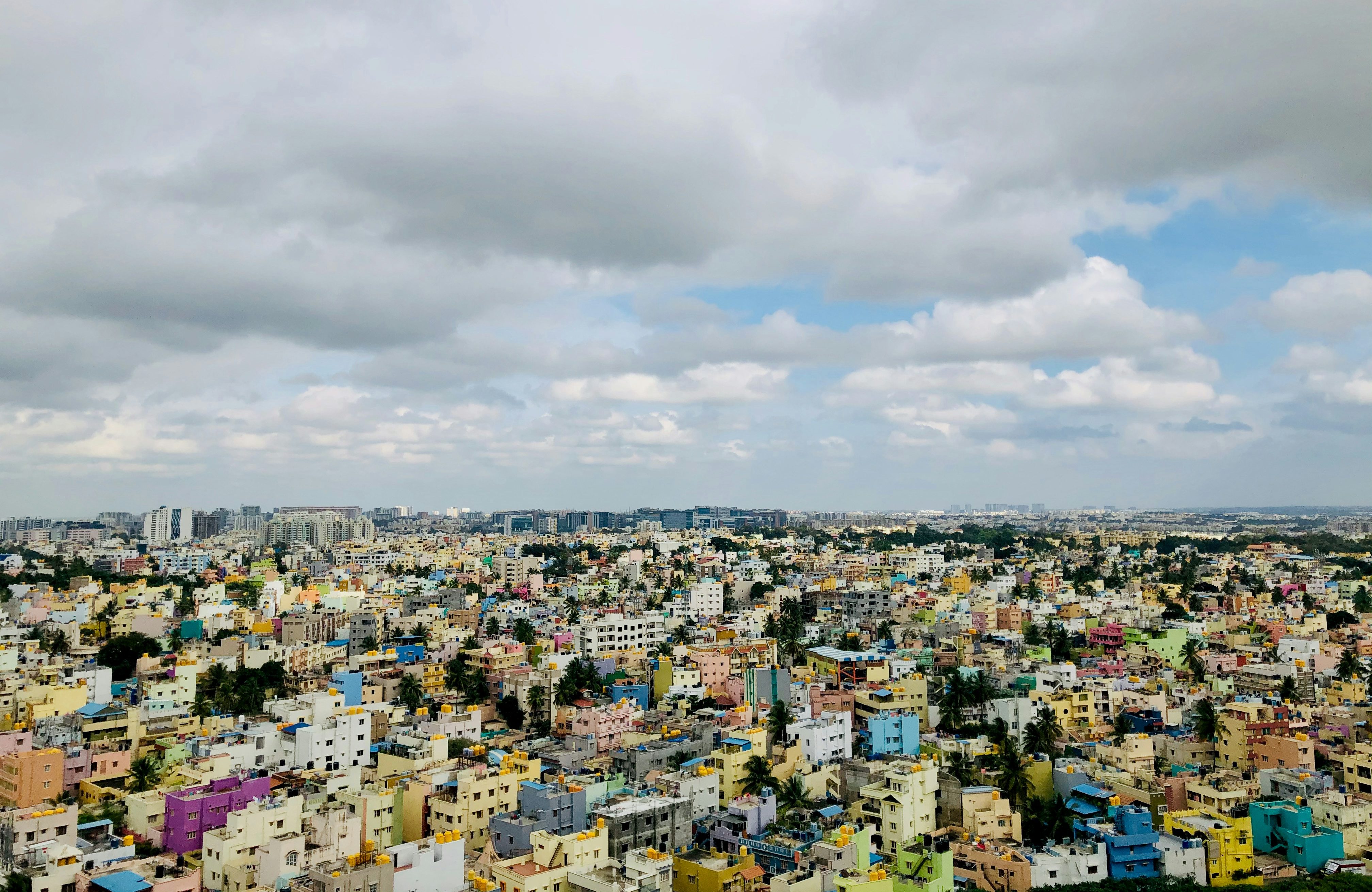
Indian cities routinely face various types of water crises, ranging from acute water scarcity to devasting urban flooding. In March 2024, as the summer was setting in, Bengaluru was staring at an unprecedented water scarcity crisis. Taps of various houses, especially those reliant on borewells and water tankers, ran dry as the city was facing a daily water deficit of 500 million litres. However, within months, as the monsoon brought about excess rain, the city was in the throes of urban flooding.
As a response to the water crisis in the summer, the Government of Karnataka (the state whose capital is Bengaluru) impounded private water tankers and redirected them to supply water to areas of its choice. Recently, as a response to urban flooding, the government has begun a demolition drive against “unauthorised buildings”. So, the state tends respond to such crises through publicised quick-fix action.
However, these crises point to fundamental infirmities in the way urban planning, water governance, and local governance is organised in Indian cities. In a recent talk titled “Urban Planning, Water Governance, and the Law”, I examined how the laws, structures, and rationalities underlying master plans engage with urban water governance in India. This was part of the TREADS (Transboundary Rivers, Ecologies & Development Studies) Talk Series on the theme of “Water-Centric Master Planning in India” organised by the Centre for Policy Research (CPR), New Delhi.
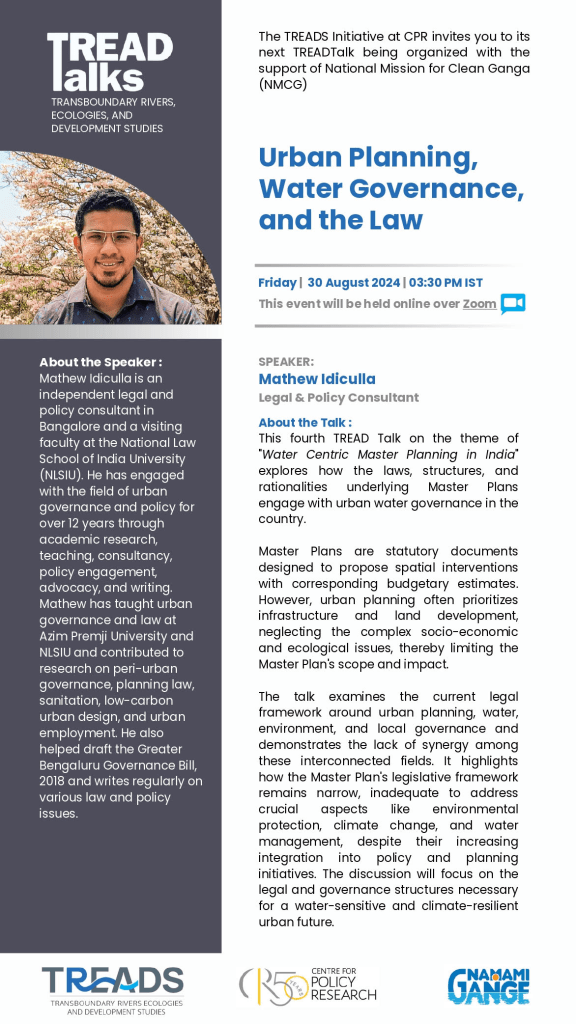
The talk examined how water is undergirded by a set of laws, policies, and regulations, in India and explored the lack of synergy between the legal and policy frameworks for urban planning, water, environment, and local governance. It specifically examined the legislative framework of the master plan and the extent to which it considers questions like environmental protection, climate change, and water management. Based on an analysis of the gaps in the prevailing system, it also discussed possible legal frameworks that can incorporate water-sensitivity and climate-resilience into urban planning and governance in India.
While the water crises facing Indian cities have gained a lot of public attention, the legal and planning framework governing urban water has not been analysed much. The existing legal framework for water governance is archaic and fragmented. The rights over groundwater, for example, is still governed by the 1882 Indian Easements Act. Further, municipal governments in most Indian cities are weak and do not possess much powers over water, with water supply in some cities being vested with state government-controlled public utilities. Presently, there is no framework that considers various aspects of water governance- water supply, groundwater regulation, wastewater management etc- in an integrated manner.
In case of urban planning, Indian cities continue to follow a planning law regime which is largely based on the modernist British planning system, long undone in the United Kingdom, which institutes the “Master Plan” as the core instrument of planning with the force of law. However, under this planning legislation, the master plan is largely restricted to regulating land use and buildings, and does not provide for socio-economic or environmental planning. Though recent urban planning initiatives have sought to incorporate various other elements, including water, environment, and climate change in the master plan, the planning law and enforcement mechanisms remain narrowly framed.
Addressing the urban water challenges requires a fresh look at the urban planning, water management, and local governance systems of Indian cities. While there’s increasing policy discourse on building sustainable and climate-resilient cities, this has not translated into enforceable legal and planning instruments that can respond to rising water and climate risks. To incorporate water-sensitiveness into urban planning and governance, it is important to device new institutional frameworks that are equipped to engage with multiple institutions, with divergent mandates, operating at different scales, with varying levels of authority and governed by different laws. Hence, there should be more debate and discussion on how a more integrated system for urban water governance can be designed.

You may also like

Digital urban governance walk

Governing cities, imperfectly: Patrick Le Galès
