
Transforming metropolitan and city-regional governance
The challenges of territorial politics
This post was written by Niamh Moore-Cherry.
Internationally, the economic performance of cities – and particularly large cities – is considered crucial to national prosperity, giving rise to what has been termed a ‘metrophilia’ among public policymakers (Waite and Morgan, 2019). The economic influence of metropolitan agglomerations and importance of institutions at the metropolitan scale for organising the effective provision of urban infrastructure is growing. However, this research does not take account of dynamics particular to small states, especially where the capital city-region is also national economic driver. While rationally the economic argument for continued investment and the realignment of governance to maximise the potential of such places is obvious, the political consequences of favouring places already seen as comparatively thriving creates significant challenges grounded in territorial politics. Previous research by Moore-Cherry and Tomaney (2019) in the context of Ireland has dubbed this as a form of ‘metro-phobia’ which results in strong resistance to meaningful governance and institutional reform.
Over the last 5 years, Ireland has undergone a radical transformation of its planning and development architecture at national, regional and local level through the development of Project Ireland 2040. Through aligning a long-term approach to strategic planning with investment through the national development plan, the overall objective was to move the country to a more sustainable development trajectory grounded in more equitable growth and enhanced quality of life for all. A core aspiration was to harness the potential of the five city-regions in Ireland through the introduction of metropolitan scale planning and thinking, a new scalar construction in an Irish policy context. Implementation of the NPF has been mixed with significant technical activity and a ‘soft’ or encouraging approach to reshaping relationships and moving beyond sectoral thinking and silos. The radical transformations in urban and regional governance required to shift decades-old development trajectories have not occurred with some of the issues summarised here. Fundamentally, the centralisation of the state has become more deeply embedded through new central institutions and funding streams at the same time as there has been much discussion – much of it circular in nature – about appropriate scales and types of city-regional governance.
Currently a review of the first iteration of the National Planning framework is underway. This review is framed as a technical exercise required because of the rapidly changed context for future development identified in the results of the Census of Population of Ireland, 2022. The need for significant alterations to housing and employment targets, partly due to post-pandemic changes but primarily driven by faster than expected population growth and diversification, has become a policy concern. While framing interventions and priorities within the appropriate context is of course important, evidence to date shows that the scale of transformation required to rebalance development across the national territory, and create more efficient and integrated city-regions, requires more than tinkering with technical modelling. Some of the hard questions that have been avoided but now need to be addressed include:
- Is there a need to ‘harden’ the governance approach at the metropolitan or city-regional scale to create new and empowered city-regional actors?
- If a more innovative institutional framework was adopted, what potential responsibilities could be devolved to city-regional or metropolitan level? How would these be funded?
- What are the potential political challenges of increasing the political visibility of the city-regional or metropolitan scale in a context where the rise of ‘far-right’ politics and protest is increasingly disparaging of a so-called ‘metropolitan elite’?
- How do we maintain social cohesion and balance strengthening of metropolitan areas or city-regions with also addressing the needs of ‘left-behind’ places?
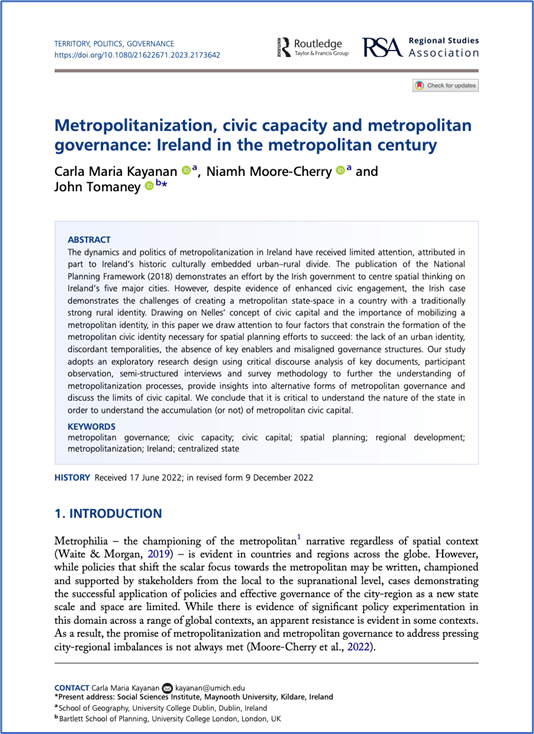
Teasing out the answers to these questions will require significant thought and further research, but in our recent paper, published in Territory, Politics, Governance, our team explores why these issues are particularly thorny in the Irish political and cultural context.
Tag:Publications

You may also like

Summer festivals & the unjust consequences of safety regulations
Bridging top-down and bottom-up mobility policy
