Summer festivals & the unjust consequences of safety regulations
This post was written by Tobias Arnoldussen.
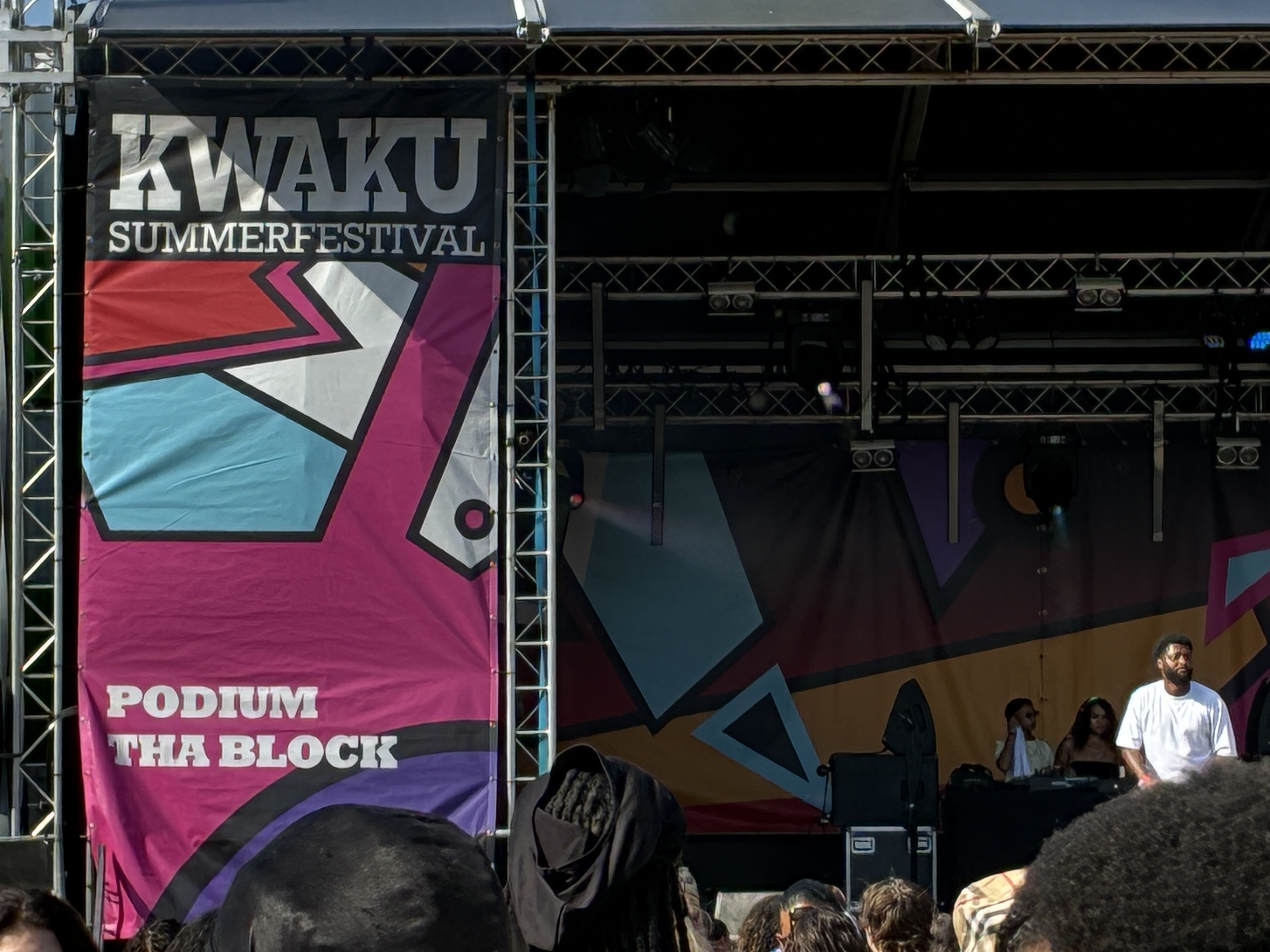
Fifty years ago, residents from the Surinamese community organised a football tournament in the Amsterdam Bijlmermeer. The Bijlmer is one of the most maligned areas of Amsterdam, with high crime rates, high unemployment, and many residents of weak socio-economic status, though liveability appears to improve. In its early days, the gathering consisted of little more than a football tournament and people selling homemade food from the trunks of their cars. The tournament was organised to give a fun summer to the youngsters living in the high-rises, who often could not go on holiday.
In the 1990s the festival became more widely known and professional: artists were booked, lectures organised, and eateries set up shop, showcasing Caribbean, Surinamese and African food. The organisation changed and became more commercial as the scale grew. The organisation is now in the hands of parties who have experience organising other festivals. Kwaku nonetheless tried to retain its atmosphere of “celebrating cultural diversity and identity through culture, sports and food” (Kwaku website). After fifty years, the festival will disappear in its current form. The organisers cite several reasons: organisational complexity, higher vendor costs, and stricter permit requirements.

The role of permit requirements raises interesting questions from a social justice perspective. Such permits exist for good reasons. They guarantee physical safety and environmental quality standards, and ensure nuisance is kept to a minimum. In environmental and spatial planning, permits also make sure that common space is not disproportionately appropriated by private interests. However, as the organisers of this festival have noticed and as numerous scholars have also observed, requirements to control risk across various domains have become steadily stricter (Beck, 1992; Boutellier, 2002; Pieterman, 2008).
This tendency towards greater precaution and less tolerance for risk appears neutral on its face; permits become more strict for everyone. Below I argue that in practice they will affect marginalised communities, immigrants and non-native speakers more than others for two reasons. The first reason is that at the end of the day complying with safety regulations and environmental permit requirements costs money, a resource that a marginalised community generally has less of. The second reason is that is that these requirements all entail more bureaucracy. As risk aversion increases, so does the number of reporting obligations, evaluations, controls and other arrangements. Such procedures not only cost money; they also increase administrative and regulatory burdens (Herd & Moynihan, 2019).

The primary reason increased safety requirements produce worse outcomes for disadvantaged communities appears to be monetary. Stricter requirements mean that more measures must be taken to improve safety, heighten security, optimise hygiene, and meet overall quality standards. Organising a festival like this one means hiring security firms, arranging mobile toilets, and having food tested, controlled and safely stored. Stages must be built to minimise noise nuisance, and electrical wiring and cabling must be laid out to minimise the risk of accidents. All of this costs money which must be recouped somehow. According to an op-ed that recently appeared in Dutch daily newspaper ‘Parool’ every edition of the Kwaku festival costs 1 million euro’s in levies and permit requirements alone.
The most obvious way to recoup those costs is through ticket pricing. A festival aimed at an affluent audience can absorb such costs by raising prices. We all understand that a safe festival costs money. But a festival originally meant to give neighbourhood kids without the means to travel a good summer cannot raise its ticket prices, as the organisation of Kwaku argued. In the best scenario such a festival becomes unaffordable for all but a few and in the worst case it disappears.

A second reason through which precautionary regulation increases marginalisation, is through the increase of administrative and regulatory burdens. Lawyer and scholar Gregg Kettles has analysed how regulatory burdens in Los Angeles on sidewalk vending allow only the most profitable vendors and those with other means to support themselves, to legally ply their trade. Moreover, the laws on sidewalk vending place storefront owners at an advantage when deciding what happens in public space, because they are allowed to have a say in what zones are designated for sidewalk vending (Kettles, 2004, 44). This example illustrates how law tends to protect the rights of established subjects over newcomers. It also shows how only profitable initiatives tend to survive, because their profits exceed their compliance costs of conforming to the administrative burden (Kettles, 2004, 43/44). I reckon that such burdens may incentivise organisers to involve experienced commercial parties, like universities were incentivised to hire consultants when confronted with audit requirements (Powers 1999, 190). The involvement of such parties with a commercial motive may well change the character of a festival like Kwaku or it may have to close when it cannot be made profitable anymore.
Taken together, these reasons lead to the conclusion that increased concern for safety will make some people’s fun more expensive, while for others, it will simply disappear. Precautionary administrative law ends up serving business models geared to the profit motive and the needs of the elite.

This concern is more than an example of the dark side of neoliberalisation. It is a problem of environmental justice (EJ). EJ activists have long argued that polluting activities are often sited in disadvantaged communities for similar reasons: such facilities tend to follow a “path of least resistance,” locating where they are expected to meet the least opposition (Saha & Mohai, 2005). EJ scholars and activists have broadened the meaning of justice beyond the fair and equal distribution of risk, to include procedural justice through the representation of such communities in decision-making. They further extend it to include recognition of past wrongs and argue for a capabilities approach that strengthens communities’ capacity to act (Schlosberg, 2007). Under the Biden administration, the US federal government launched an initiative called Justice40 to channel large amounts of investment into disadvantaged communities, supporting programmes and projects that reduce their environmental burden and build their capabilities (Fu, Williams and Shipp, 2022).
Here we find a similar situation, though in reverse: it is not the absence of rules that causes injustice, but rather an increase in them. In this case, an initiative that exemplifies grassroots participation and a community-oriented capabilities approach may come to an end, partly because of the burdens of regulation. The festival is an example of successful and ongoing ‘inclusive participation’ (Ranalli, 2026) with an explicit focus on recognitional justice (Verloo, 2025), but without the need for elaborate participatory meetings. Instead, it offers participation in action, through eating, drinking, dancing, discussing together. The festival offers a meeting space for the Surinamese diaspora community which may disappear.
This blog has focused on one example to illustrate a broader point: the growing desire for safety and risk minimisation does not affect everyone equally. For some, it merely adds a small cost to the bill in exchange for more safety. For others though, it means their activity cannot continue at all. The activities most at risk of disappearing will be those in disadvantaged communities, because they are structurally under-resourced. This widens the gap between disadvantaged and affluent communities, contrary to the aims of environmental justice. The desire for safety may also mean that such initiatives can no longer be organised in the future. Kwaku was set up in 1970s Bijlmermeer by local residents, at a time of laissez-faire governance in Amsterdam when a great deal was possible. Would it be feasible to organise even a low-key festival for local youth in that same spirit today? Perhaps, but permits and bureaucracy mean the threshold is now much higher. In short: the more safety we demand, the more fun we lose. And the people who have drawn the shortest straw already, stand to lose the most.
References
Beck, U. (1992). Risk Society: Towards a New Modernity. Sage, London.
Boutellier, H. (2002). De veiligheidsutopie: Hedendaags onbehagen en verlangen rond misdaad en straf. Den Haag: Boom Juridische uitgevers.
Fu, S., Williams, J. L., & Shipp, A. (2022). Advancing Equity, Climate Action, and Economic Health in Communities: Challenges and Opportunities for the Justice40 Initiative. Urban Institute.
Herd, P., & Moynihan, D. P. (2019). Administrative Burden: Policymaking by Other Means. Russell Sage Foundation.
Kettles, G. W. (2004). Regulating vending in the sidewalk commons. Temple Law Review, 77, 1, 1-46.
Pieterman, R. (2008). De Voorzorgcultuur: Streven naar veiligheid in een wereld vol risico en onzekerheid. Den Haag: Boom Juridische uitgevers.
Power, M. (1999). The Audit Society: Rituals of Verification. Oxford University Press.
Ranalli, F. (2026, Jun 22). Young voices, creative methods!. Ugovern. https://ugovern.eu/?s=inclusive.
Saha, R., & Mohai, P. (2005). Historical Context and Hazardous Waste Facility Siting: Understanding Temporal Patterns in Michigan. Social Problems, 52(4), 618–648.
Schlosberg, D. (2007). Defining Environmental Justice: Theories, Movements, and Nature. Oxford: Oxford Academic online edition.
Verloo, N. (2025, October 12). Recognitional justice and the politics of citizen participation in urban development. UGovern. https://ugovern.eu/events/recognitional-justice-and-the-politics-of-citizen-participation-in-urban-development/

You may also like
Bridging top-down and bottom-up mobility policy

Regulatory tools for affordable housing